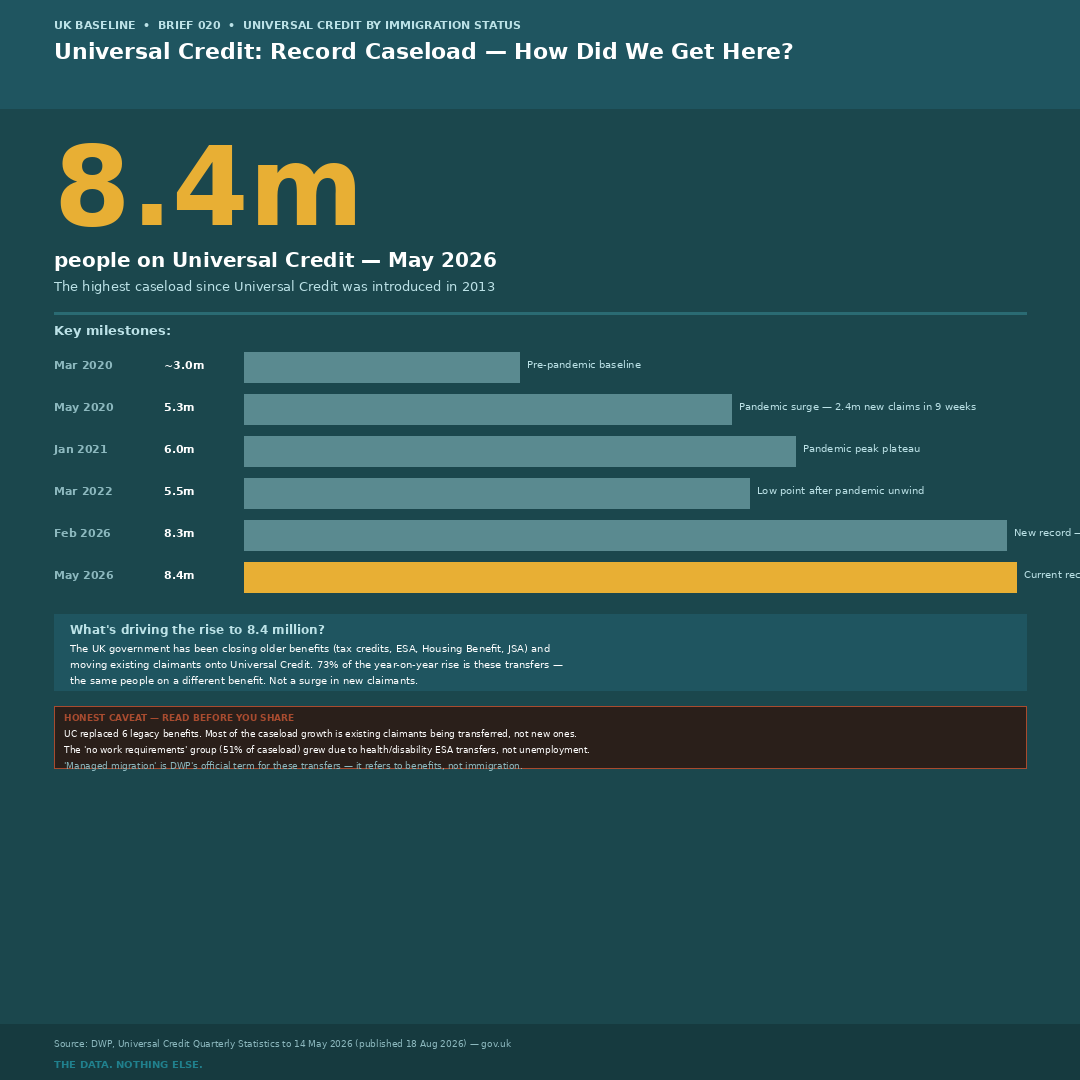
The Scale: 8.4 Million
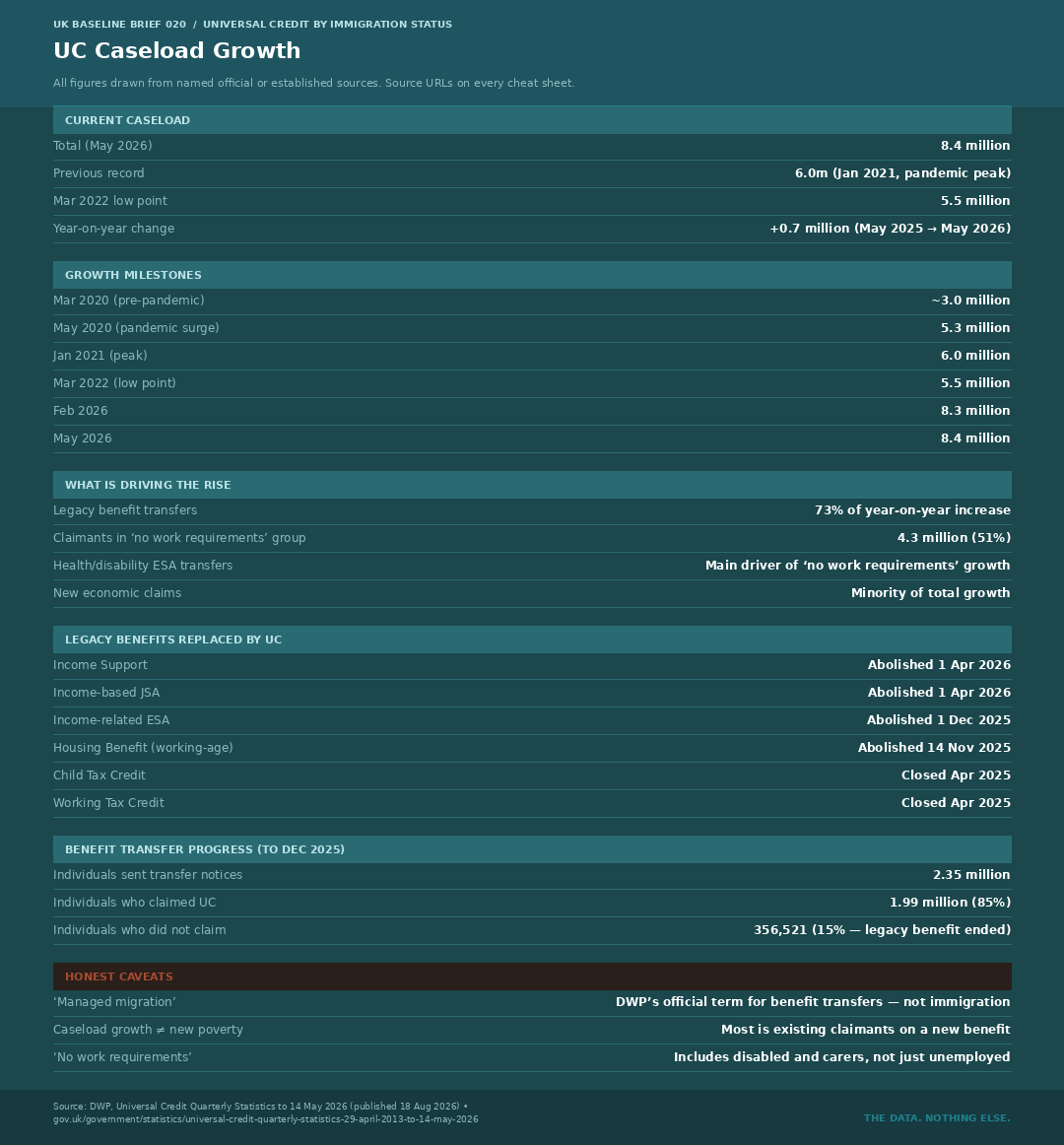
Universal Credit now covers 8.4 million people in Great Britain — the highest number since the benefit was introduced in 2013. The rise is not primarily driven by new economic hardship. The government has been closing six older benefits — including tax credits, Employment and Support Allowance and Housing Benefit — and transferring existing claimants onto Universal Credit. DWP data show that 73% of the year-on-year increase between May 2025 and May 2026 came from these transfers, not from new claims.
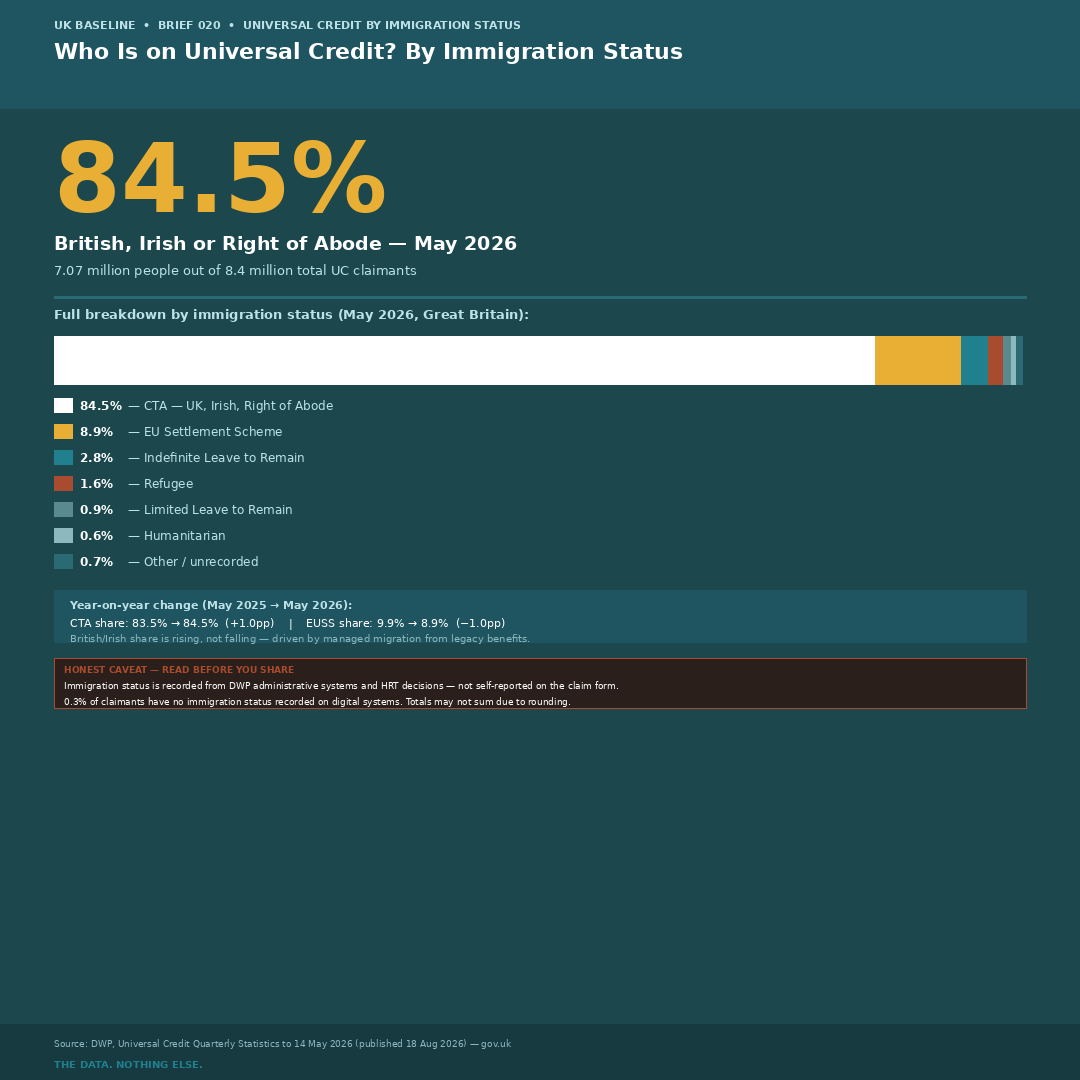
Who Is on Universal Credit?
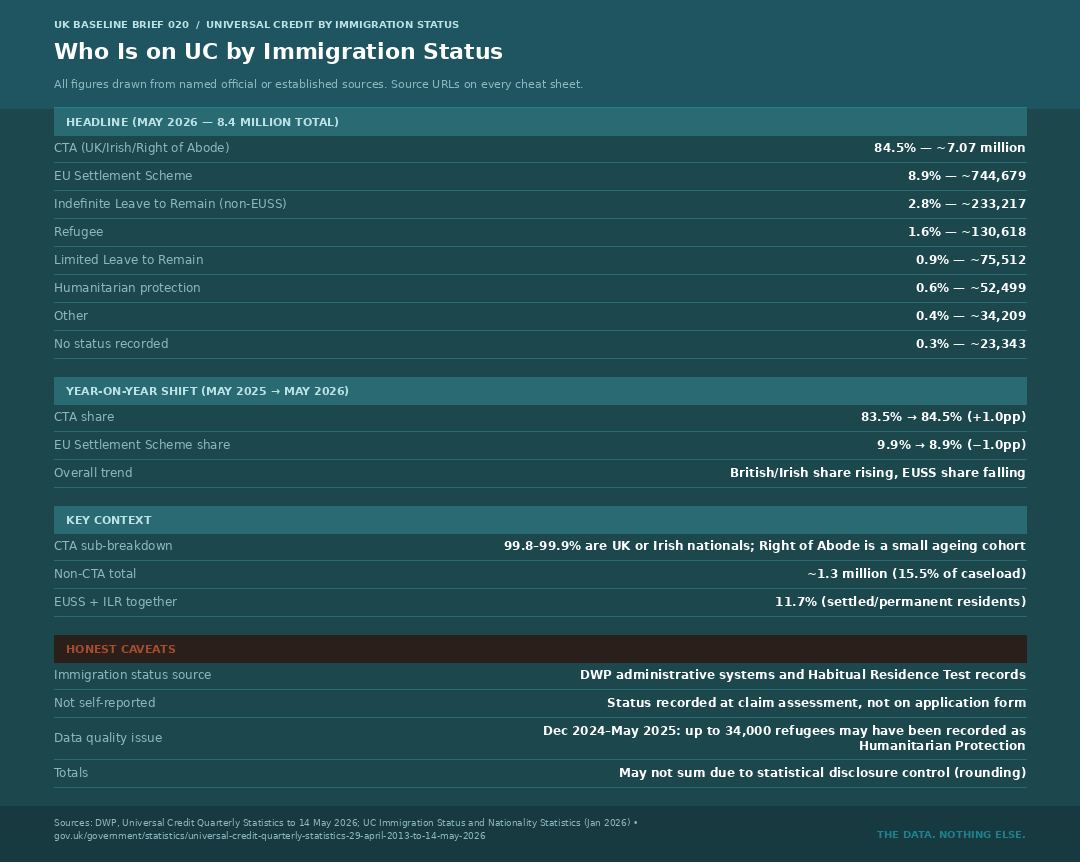
84.5% of UC claimants hold CTA status — British nationals, Irish nationals, or people with Right of Abode. DWP's own data show that 99.8–99.9% of this group are UK or Irish nationals; Right of Abode holders are a small, ageing cohort. The CTA share has been rising year-on-year, from 83.5% in May 2025 to 84.5% in May 2026, as the legacy benefit transfer programme brings long-established UK residents onto the UC system. The EU Settlement Scheme share has fallen from 9.9% to 8.9% over the same period.
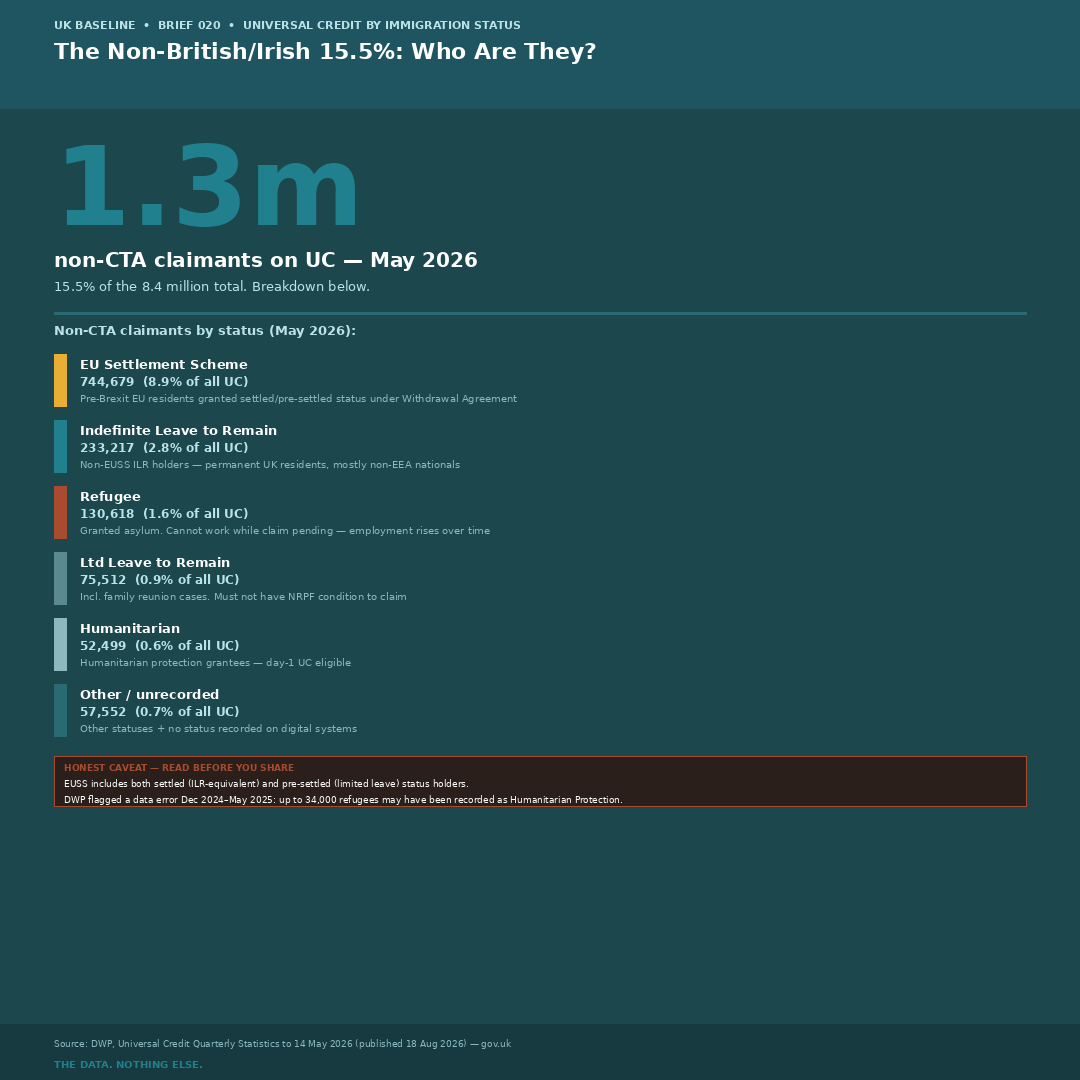
The Non-CTA 15.5%
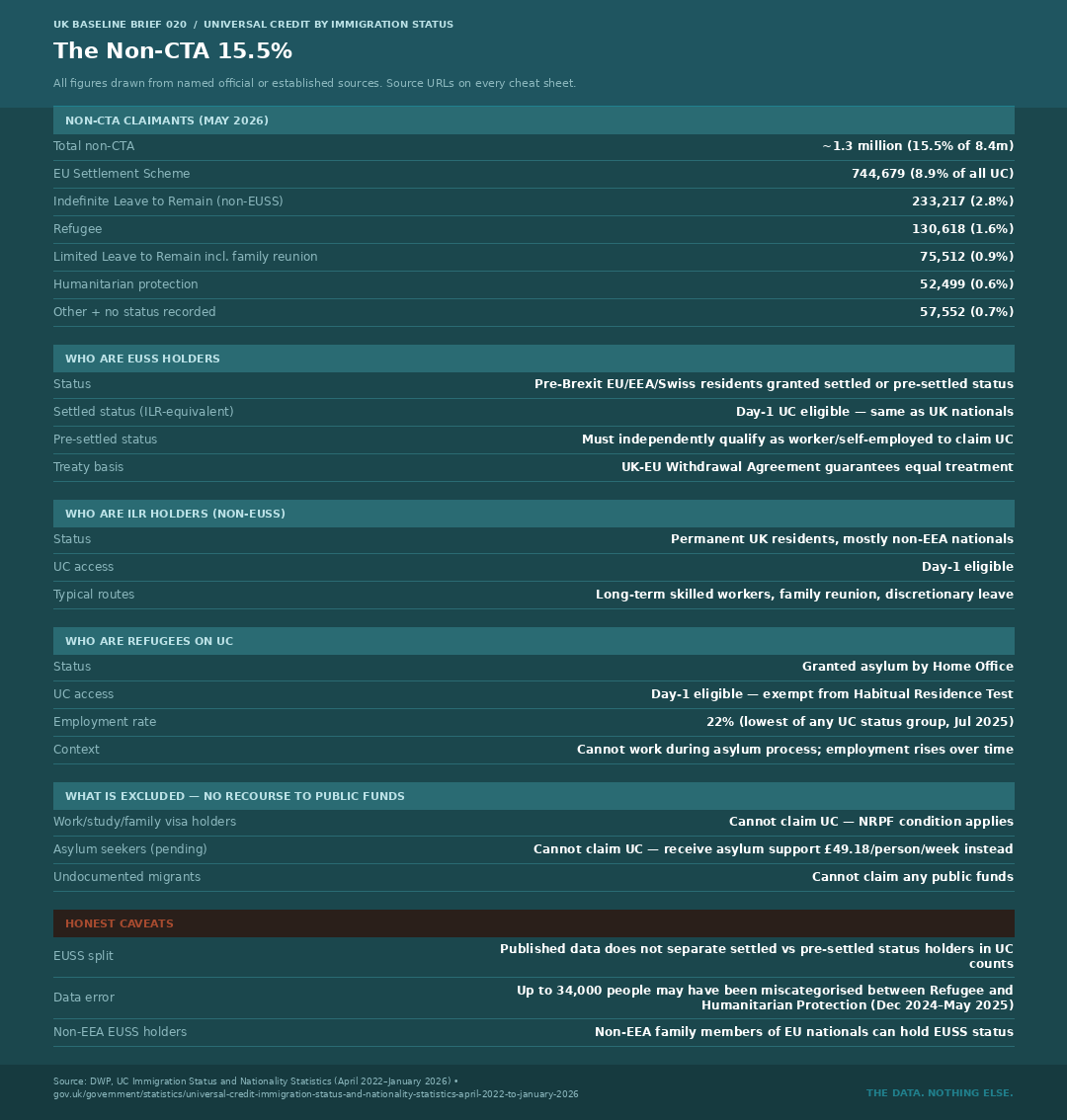
Approximately 1.3 million UC claimants hold non-CTA immigration status. The largest group — EU Settlement Scheme holders at 8.9% of the total caseload — are EU, EEA and Swiss nationals who were resident in the UK before Brexit and were granted settled or pre-settled status under the UK-EU Withdrawal Agreement. Refugees and humanitarian protection grantees together account for 2.2% of the caseload. The groups most commonly associated in public debate with welfare use — recent arrivals on work or study visas — are almost entirely excluded from UC by the No Recourse to Public Funds condition, which applies to most temporary visa categories.
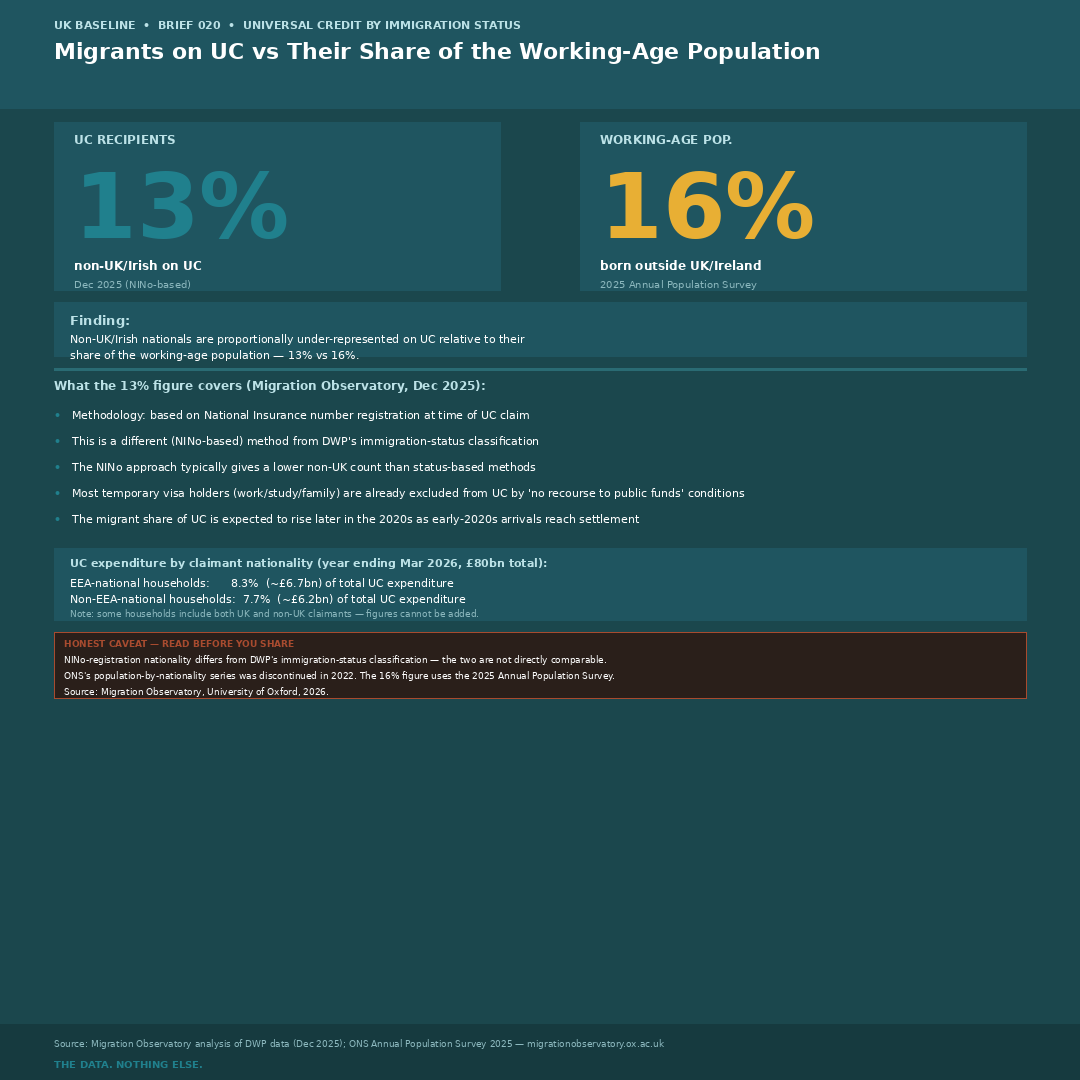
Migrant Share vs Population Share
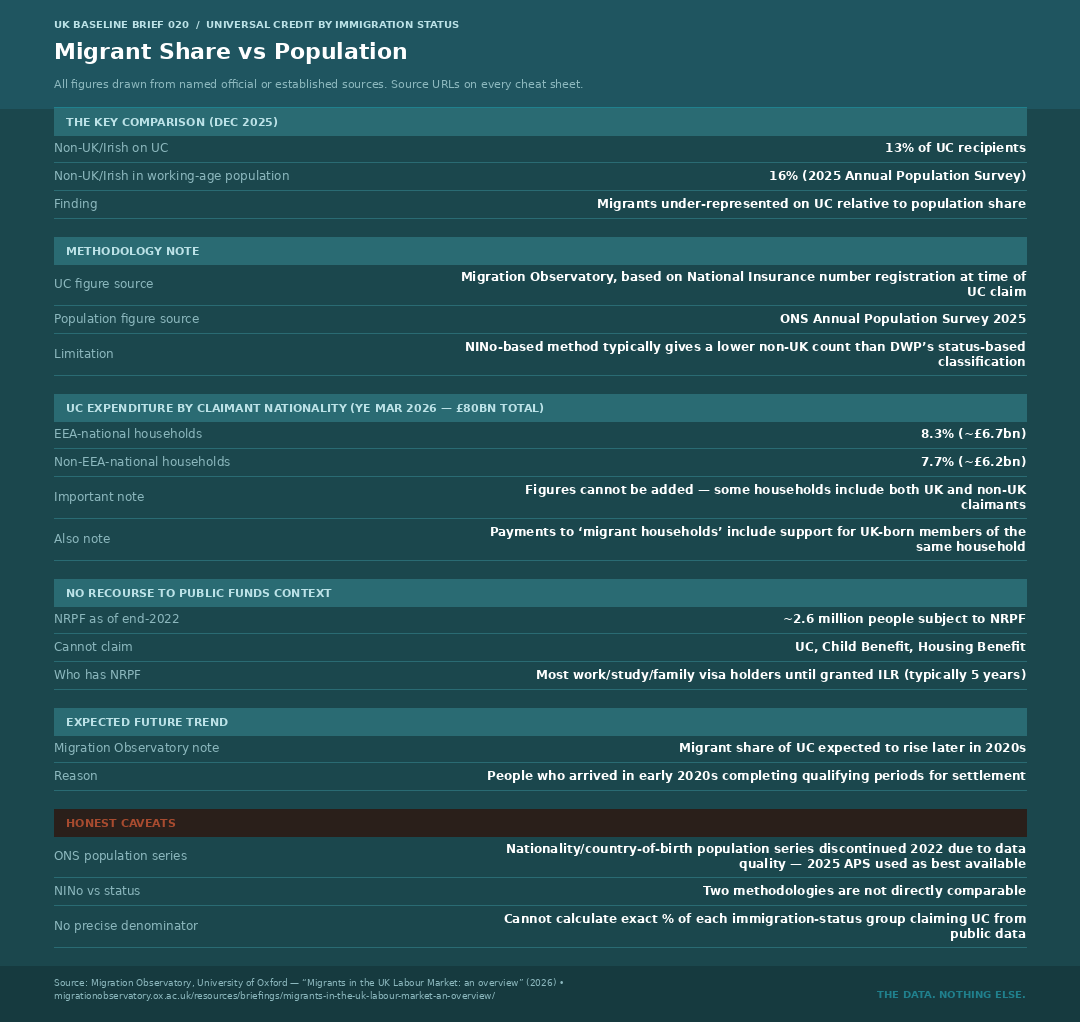
The Migration Observatory at the University of Oxford has produced the most robust independent comparison available. Using National Insurance number registration records, it found that 13% of UC recipients in December 2025 were non-UK and non-Irish nationals — below their 16% share of the working-age population according to the 2025 Annual Population Survey. On this measure, migrants are proportionally under-represented on Universal Credit relative to their share of the population. The OBR has separately noted that most new migrants are ineligible for benefits for at least the first five years, and that the fiscal impact of migration on welfare spending is "very small" over its five-year forecast horizon.
Refugees: A Specific Pattern
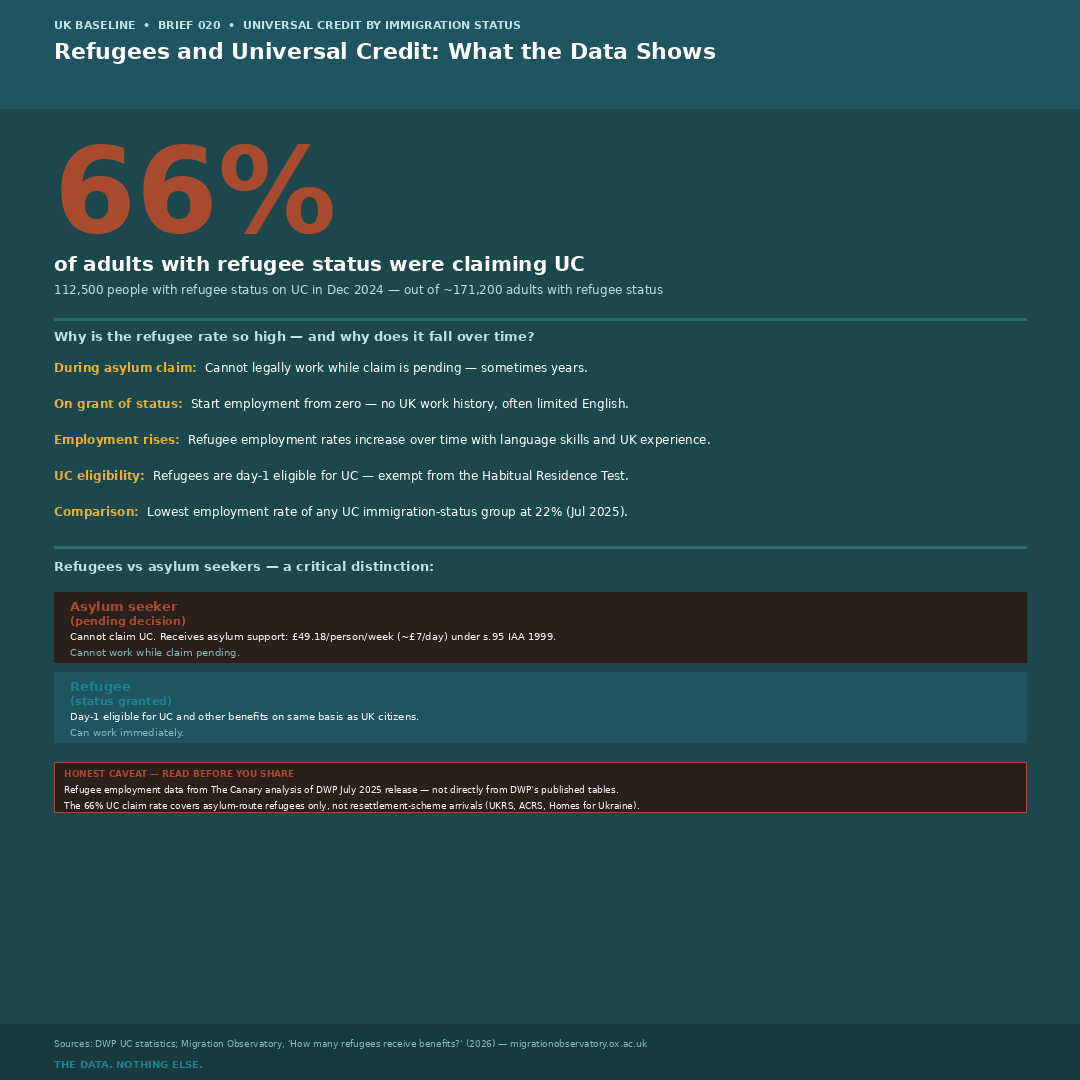
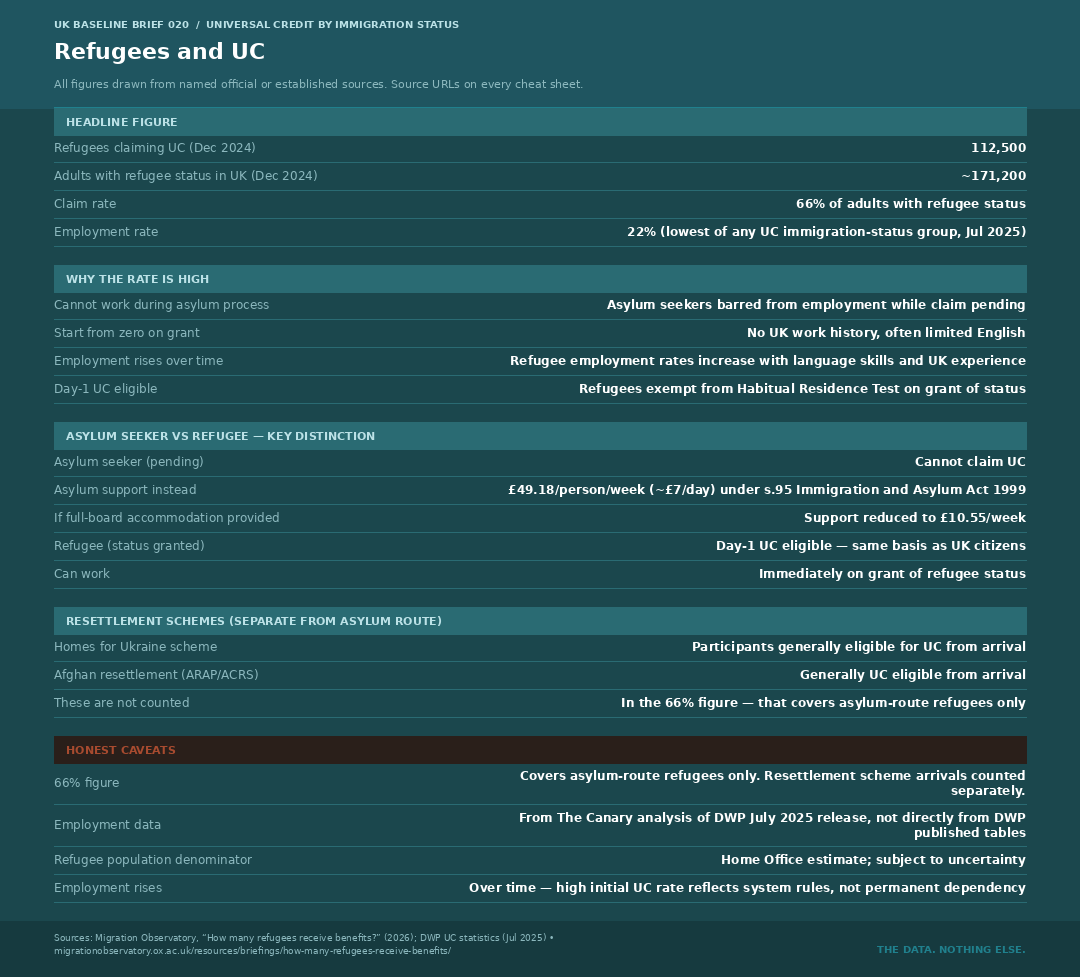
Refugees show the highest UC claim rate of any immigration-status group: 66% of adults with refugee status were claiming UC in December 2024. This reflects the structure of the asylum system rather than individual choice. Asylum seekers cannot legally work while their claim is being decided — a process that can take years — and receive separate asylum support of £49.18 per person per week instead. On being granted refugee status, a person becomes immediately eligible for Universal Credit and employment, starting with no UK work history and often limited English. Migration Observatory data show that refugee employment rates rise over time as language skills and UK-specific experience develop.
Cheat Sheets
Five cheat sheets covering the full data in this brief. Source URLs on every sheet.
Sources
- DWP — Universal Credit Quarterly Statistics to 14 May 2026 (published 18 August 2026)
- DWP — UC Immigration Status and Nationality Statistics, April 2022–January 2026
- DWP — Advice for Decision Making, Chapter C1: UC International Issues
- Migration Observatory, University of Oxford — Migrants in the UK Labour Market: An Overview (2026)
- Migration Observatory — How Many Refugees Receive Benefits? (2026)
- OBR — The Impact of Migration on the Fiscal Forecast
- House of Commons Library — Statistics on Migrants and Benefits