What "Border Controls" Actually Means
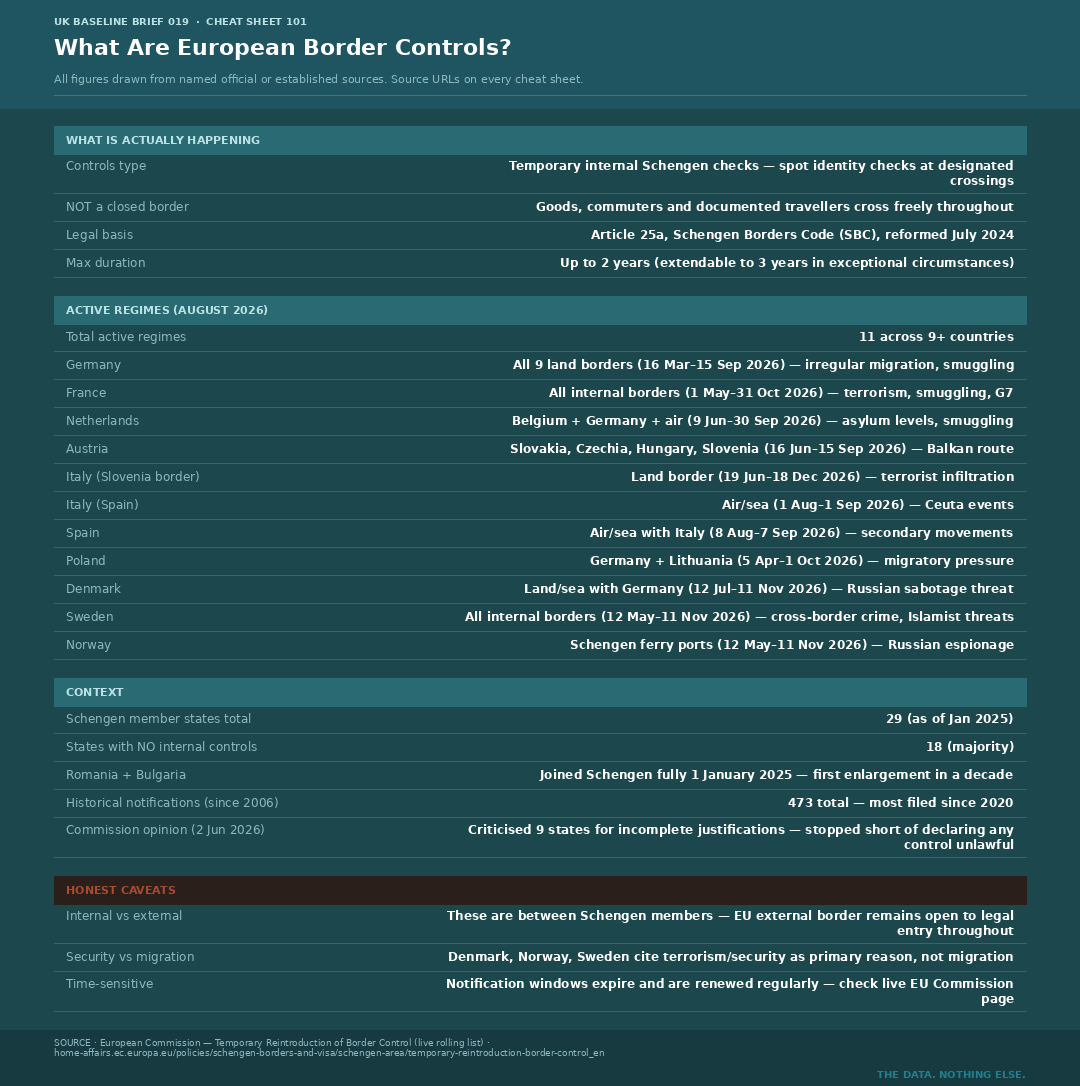
When media reports describe European countries "closing their borders", the legal and operational reality is more specific. What is happening is the temporary reintroduction of identity checks at designated crossings between Schengen Area member states — known as internal border controls — under Articles 25 and 25a of the Schengen Borders Code. These are not the same as closing borders. Goods, commuters and travellers with valid documents continue to cross freely. Visa requirements do not change. What changes is that officers may ask for a passport or ID at designated points where none was previously required.
As of August 2026, the European Commission lists 11 active control regimes across nine or more countries. Germany's controls — covering all nine of its land borders — are the most extensive and have been running in some form since September 2015. Eighteen of the 29 Schengen member states currently have no internal controls at all.
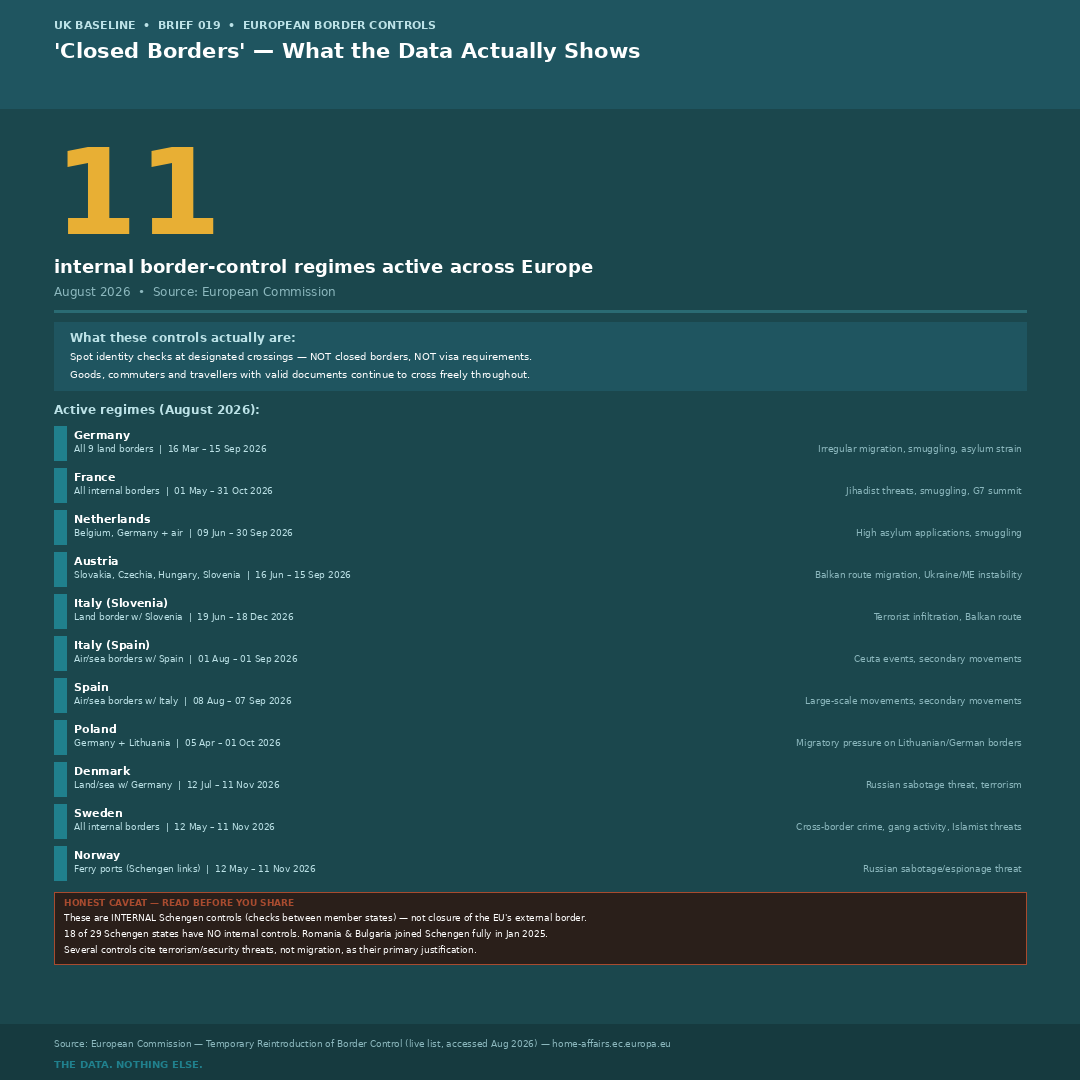
These are INTERNAL Schengen controls — checks between member states, not closure of the EU's external border. Several regimes (Denmark, Norway, Sweden) cite terrorism and Russian sabotage as their primary justification, not migration. Notification windows expire and are renewed regularly — check the live European Commission page for the current list.
Crossings: Down 90% From the 2015 Peak
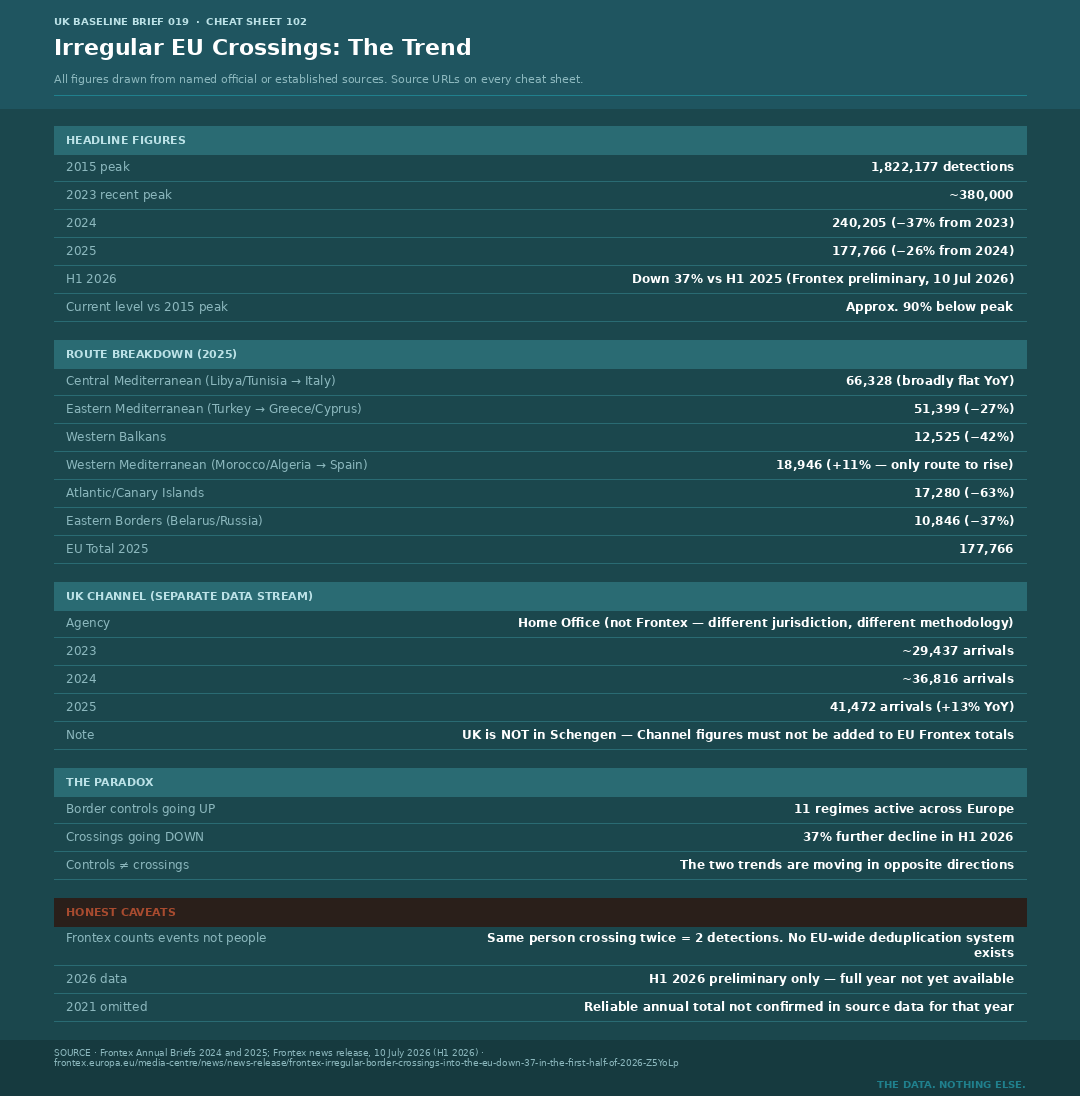
Frontex — the EU's border and coast guard agency — detected 240,205 irregular crossings at the EU's external borders in 2024, down 37% from 2023's figure of around 380,000. In the first half of 2026, crossings fell a further 37% compared to the same period in 2025, reaching approximately 55,000 — the lowest half-year total in over a decade. The current level is roughly 90% below the 2015 peak of 1.82 million detections, which was driven by the Syrian civil war.
The central data paradox of European border policy in 2026: the number of active control regimes is rising while the number of irregular crossings is falling. Controls and crossings are not tracking together.
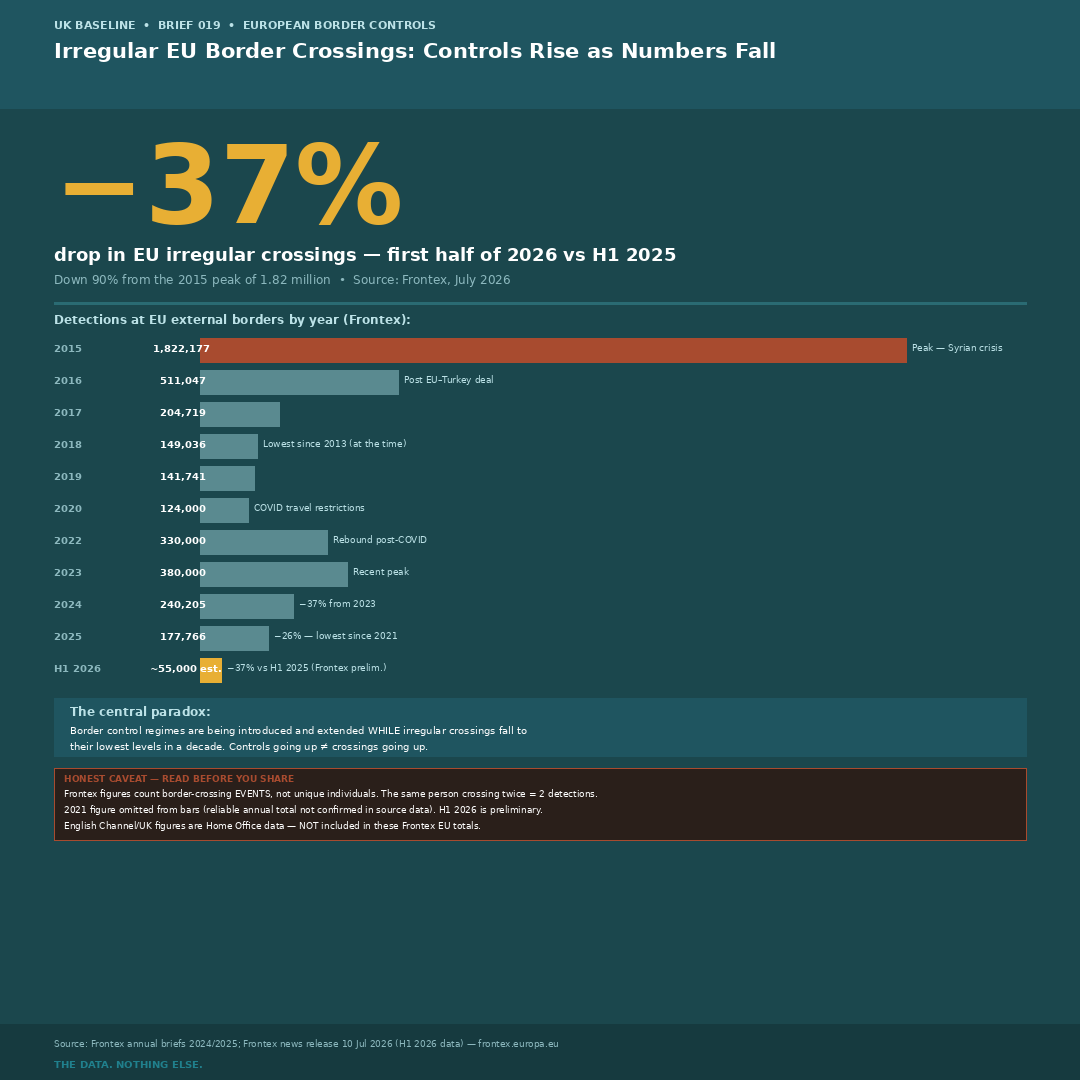
Frontex figures count border-crossing events, not unique individuals. The same person crossing twice counts as two detections. H1 2026 data is preliminary. UK Channel crossings are Home Office data under a different jurisdiction and methodology — they must not be added to EU Frontex totals.
Germany in Detail
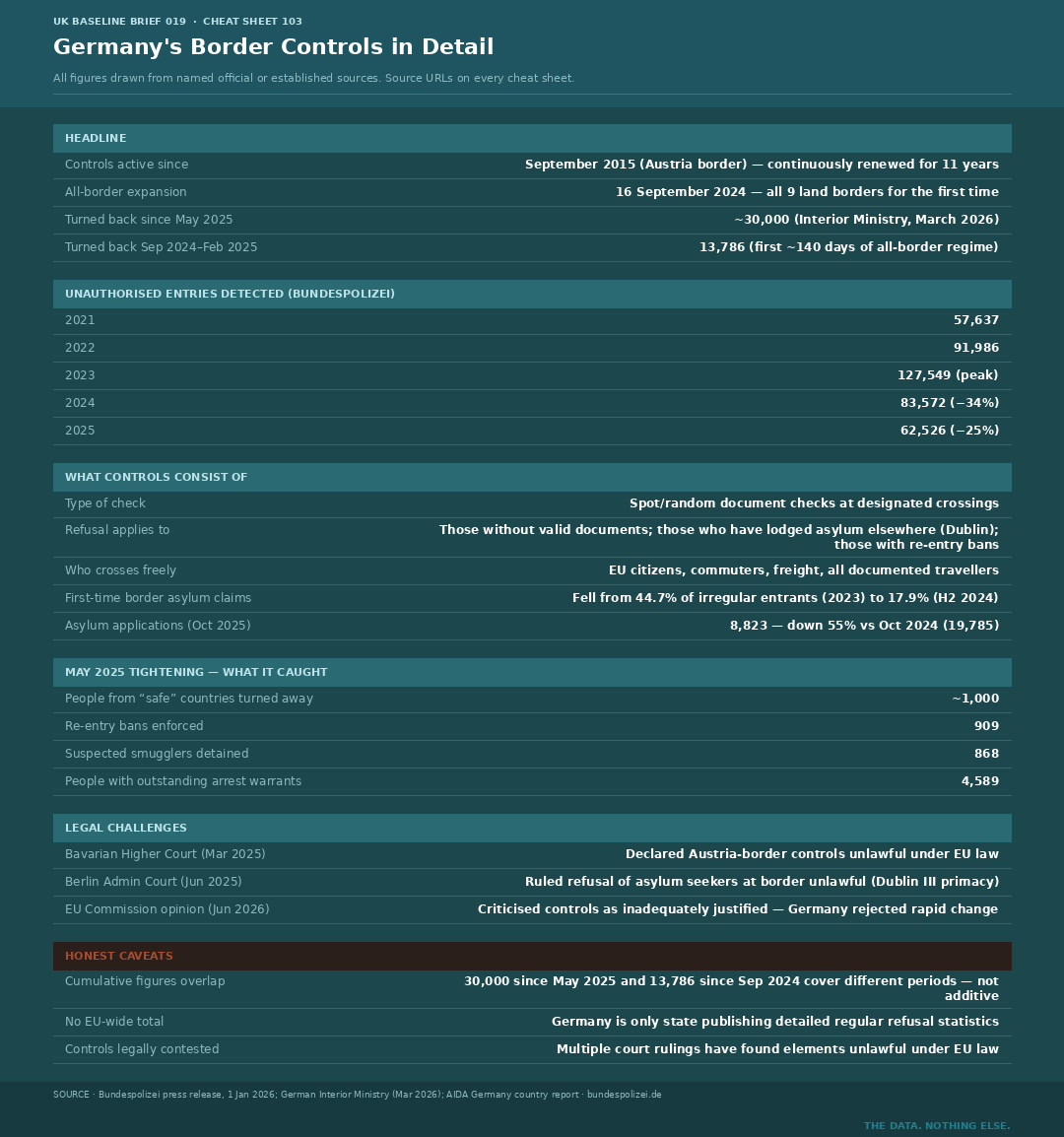
Germany's controls are the most extensive in the Schengen Area. Checks at the Austrian border have been running continuously since September 2015 — eleven years — under rolling six-month renewals. In September 2024 Germany extended controls to all nine of its land borders for the first time simultaneously. Between that point and February 2025, German Federal Police (Bundespolizei) recorded 13,786 unauthorized entries detected under the new regime. By March 2026, Interior Minister Dobrindt reported that approximately 30,000 people had been turned back since a further tightening in May 2025.
Unauthorized entries detected by Bundespolizei peaked at 127,549 in 2023 and have since fallen: 83,572 in 2024 and 62,526 in 2025. These controls have faced legal challenge. The Bavarian Higher Administrative Court ruled in March 2025 that the Austria-border controls were unlawful under EU law. A Berlin Administrative Court ruled in June 2025 that refusing asylum seekers at the border was unlawful given the primacy of the Dublin III Regulation.
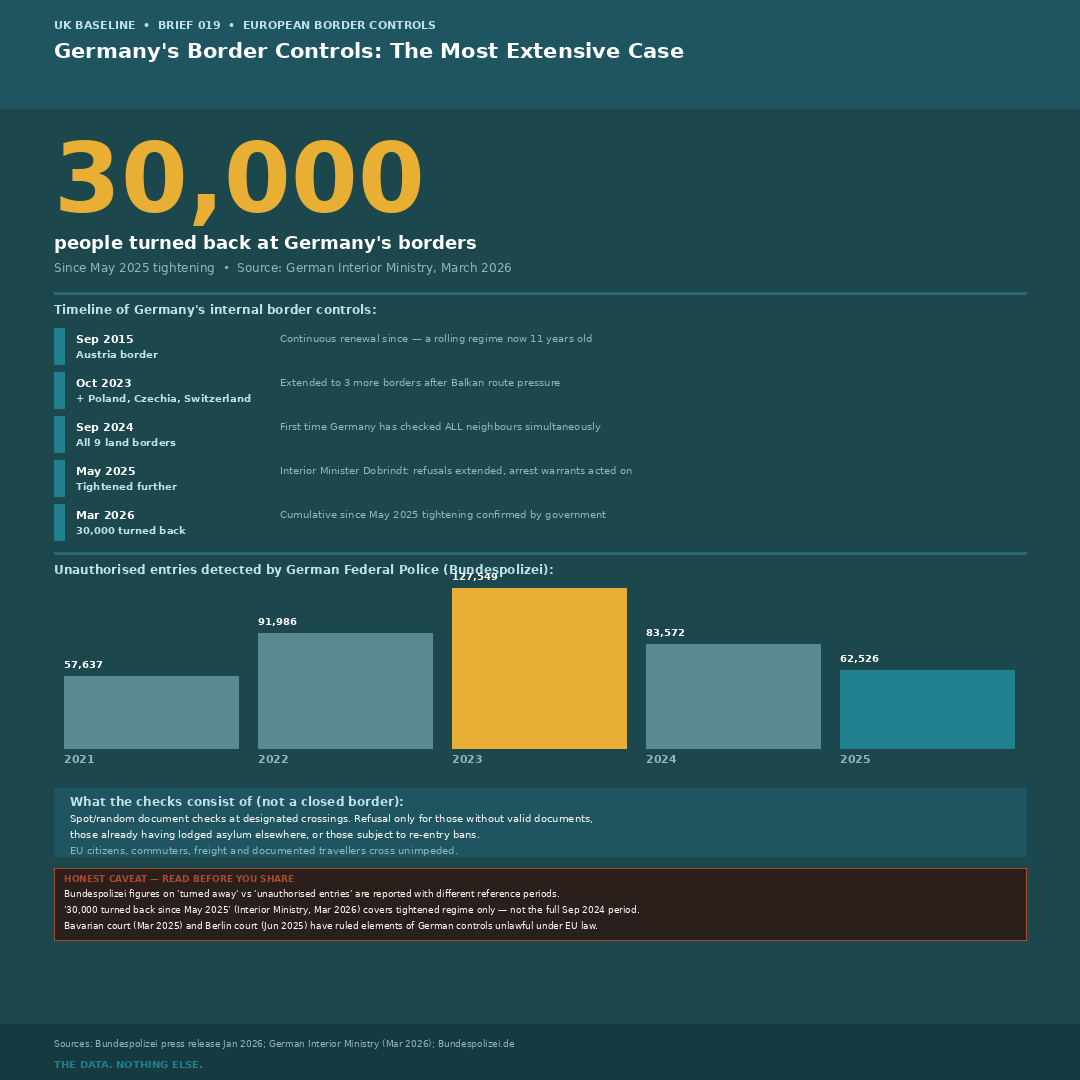
The "30,000 turned back since May 2025" and "13,786 since September 2024" figures cover different reference periods and are not additive. Germany is the only state publishing detailed regular refusal statistics — comparable EU-wide totals do not exist. Multiple court rulings have found elements of Germany's controls unlawful under EU law; the legal position remains contested.
Who Is Crossing? Nationality and Asylum Outcomes
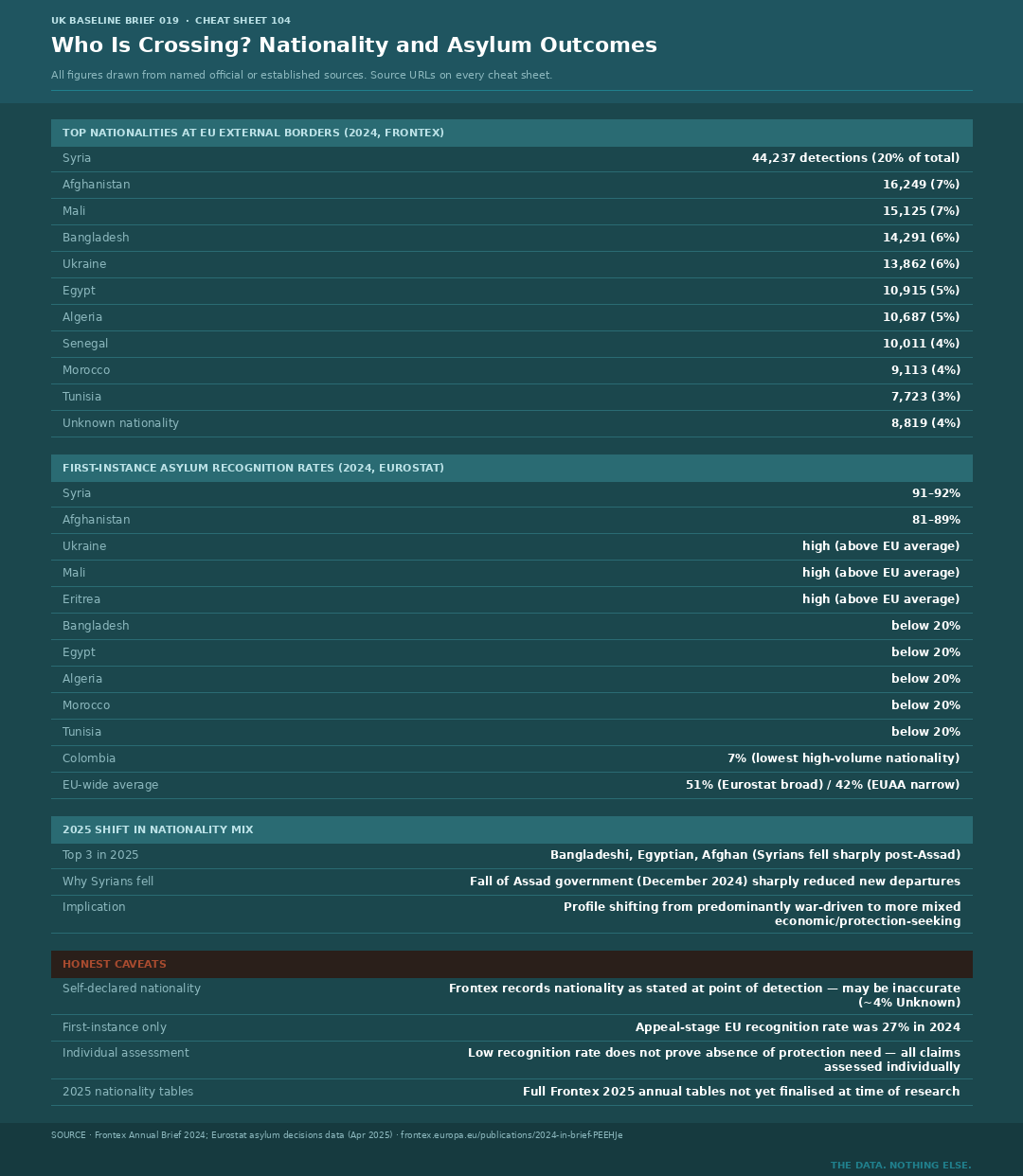
Syria was the largest source nationality at EU external borders in 2024, accounting for 44,237 detections — approximately 20% of the total. Syrians also have the highest first-instance asylum recognition rate of any high-volume group: 91–92% in 2024. Afghanistan (16,249 detections, 81–89% recognition rate) and Mali (15,125, ~75%) follow, both with recognition rates reflecting genuine protection needs.
By contrast, Bangladesh (14,291 detections), Egypt (10,915), Algeria (10,687), Morocco (9,113) and Tunisia (7,723) all have first-instance recognition rates below 20%. The nationality mix shifted significantly in 2025: following the fall of Assad's government in December 2024, Syrian arrivals dropped sharply, and Bangladeshi, Egyptian and Afghan nationalities became the top three. About 4% of 2024 detections recorded nationality as unknown.
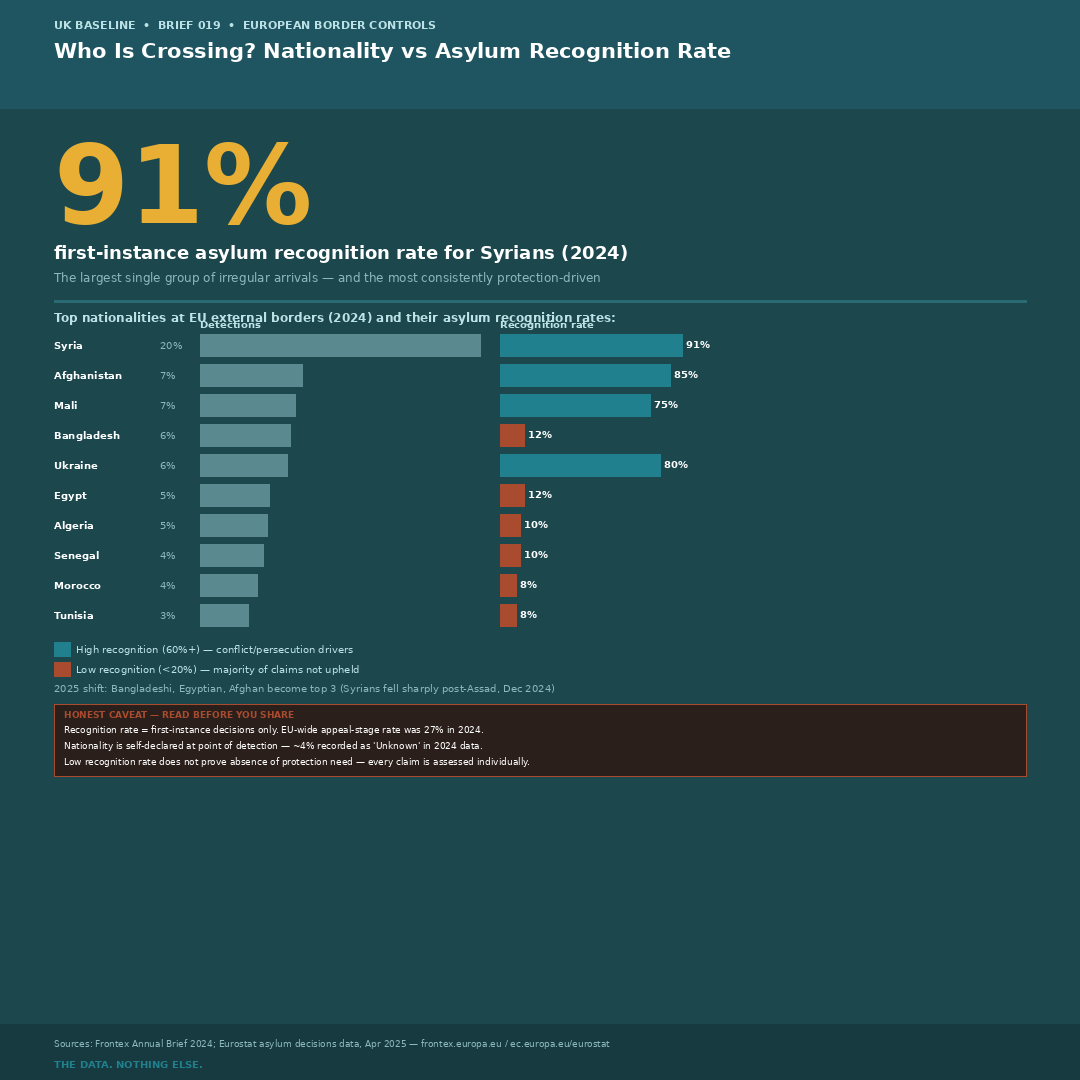
Nationality is self-declared at the point of detection. The EU-wide appeal-stage recognition rate was 27% in 2024 — substantially higher than first-instance for low-recognition nationalities. A low recognition rate does not establish absence of a protection need; every claim is assessed individually on its facts.
EU Asylum Applications: Falling From Their Peak
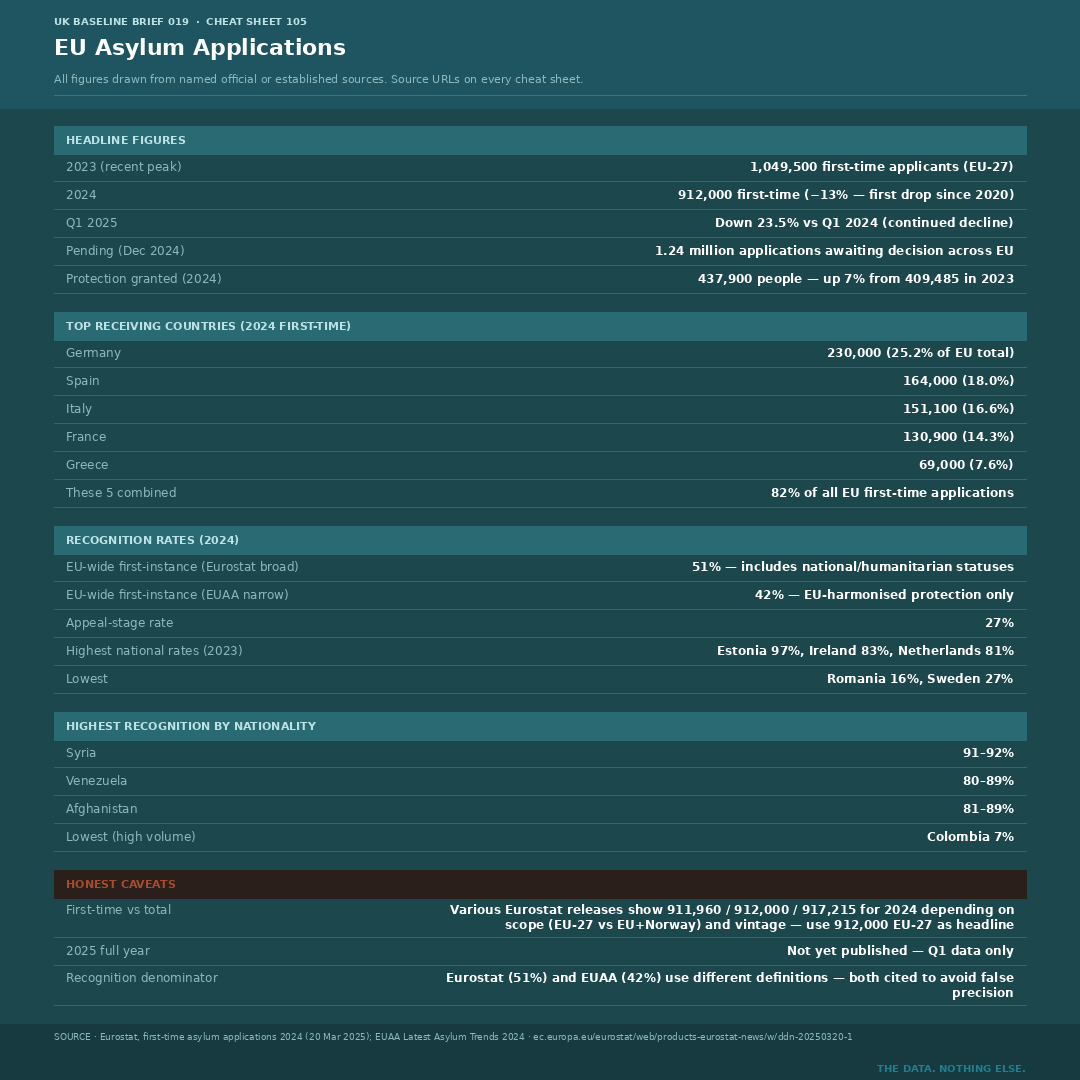
The EU recorded 912,000 first-time asylum applications in 2024 — down 13% from 2023's recent peak of 1,049,500. This was the first annual decline since 2020. In Q1 2025, applications fell a further 23.5% year-on-year, indicating the trend continued into 2025. Five countries — Germany (25.2%), Spain (18.0%), Italy (16.6%), France (14.3%) and Greece (7.6%) — accounted for 82% of all EU first-time applications in 2024.
The EU-wide first-instance recognition rate was 51% in 2024 on the Eurostat broad measure (which includes national and humanitarian statuses) and 42% on the EUAA's narrower EU-harmonised measure. Across the EU, 437,900 people were granted protection in 2024 — up 7% from 2023. At year-end 2024, 1.24 million applications were pending decision across EU member states.
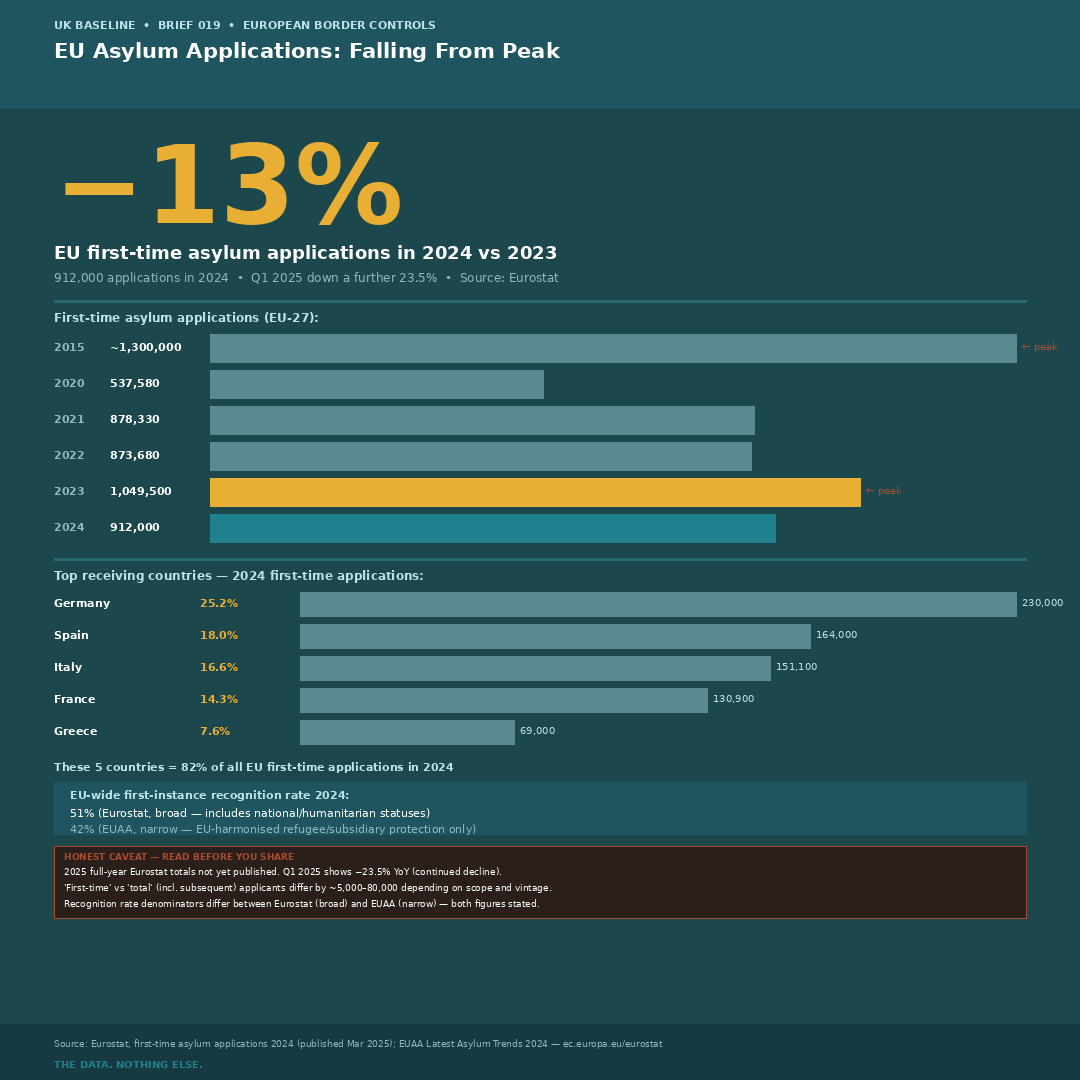
The 2025 full-year Eurostat total has not yet been published. Different Eurostat releases show slightly different 2024 totals (911,960 / 912,000 / 917,215) depending on scope (EU-27 vs EU plus Norway) and vintage — 912,000 is the EU-27 headline figure. Eurostat (51%) and EUAA (42%) recognition rates use different definitions; both are cited to avoid false precision.
The Policy Response: Frontex and the Migration Pact
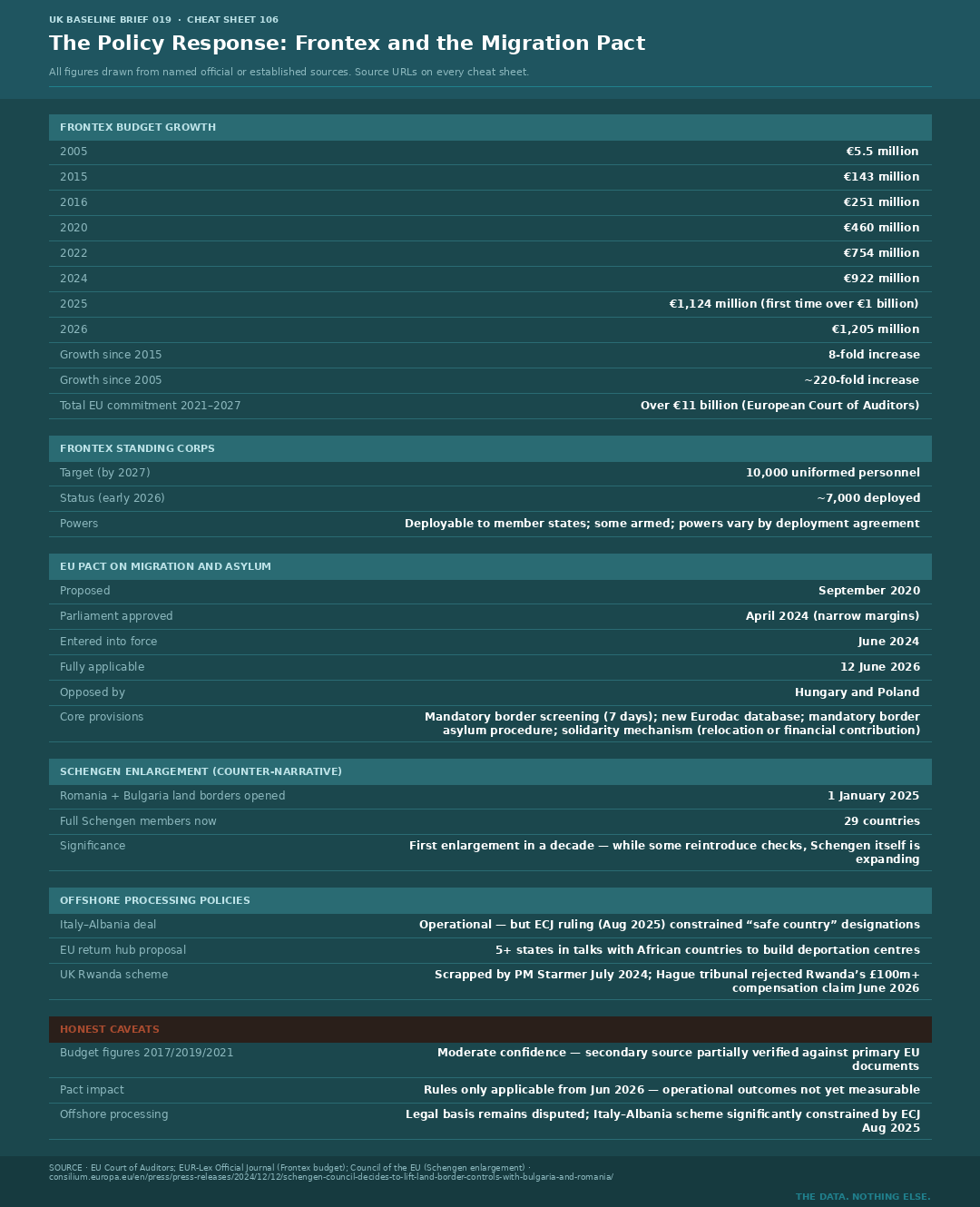
The European Union has increased investment in external border management substantially since 2015. Frontex's annual budget has risen from €143 million in 2015 to €1.205 billion in 2026 — an eightfold increase. The agency's standing corps is being built toward a target of 10,000 uniformed personnel by 2027; approximately 7,000 were deployed in early 2026.
The EU Pact on Migration and Asylum — a package of ten laws agreed after four years of negotiations — was adopted by the European Parliament in April 2024 and became fully applicable across all member states on 12 June 2026. Its key provisions include a mandatory seven-day border screening procedure, a new Eurodac database linking biometrics to asylum records, a mandatory border asylum procedure, and a solidarity mechanism requiring member states either to relocate asylum seekers from frontline countries or to make financial contributions instead.
The counter-narrative that is rarely part of the "closed borders" framing: Romania and Bulgaria became full Schengen members with open land borders on 1 January 2025 — the first Schengen enlargement in over a decade, expanding the passport-free zone to 29 countries at the same time as some members reintroduce temporary checks within it.
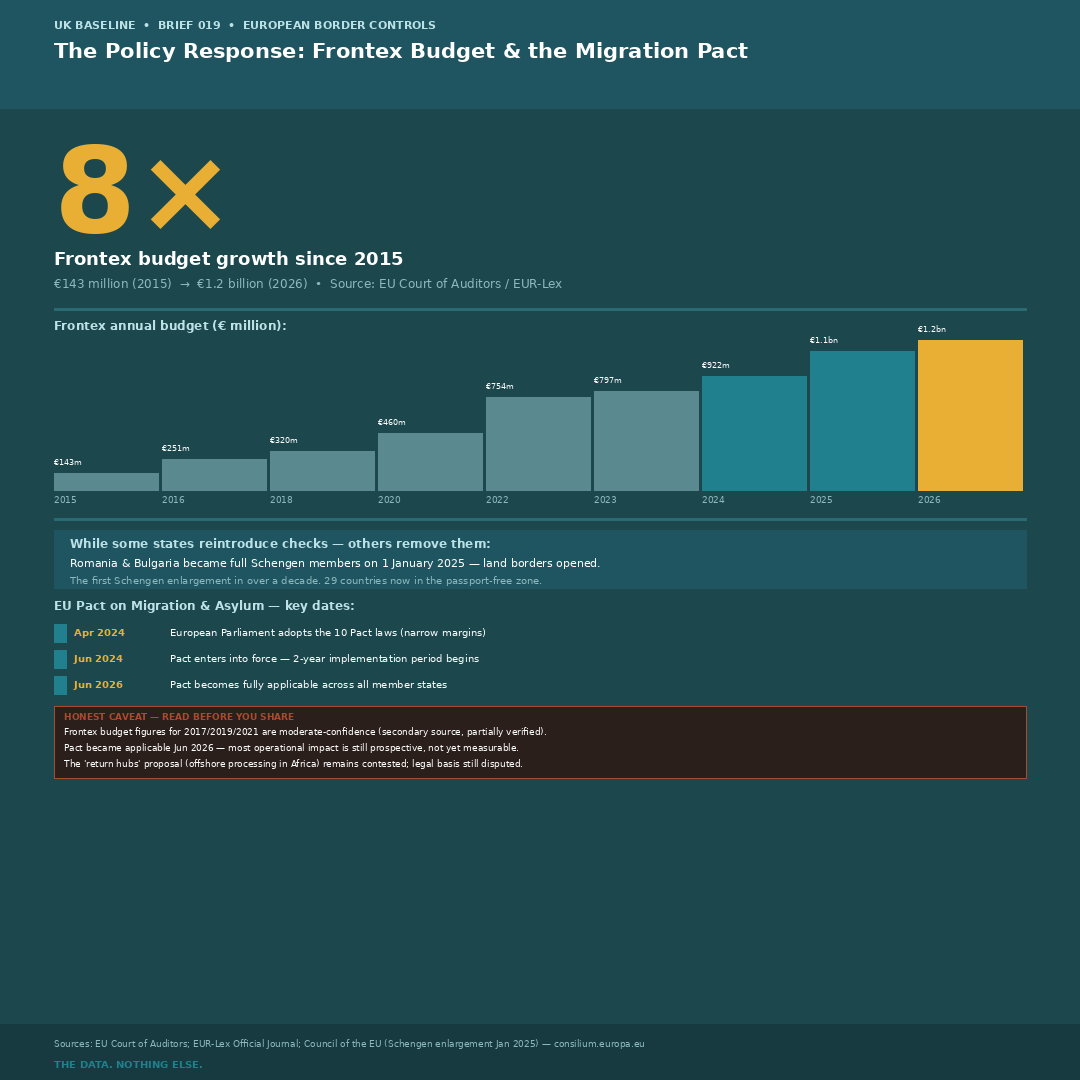
The EU Pact became applicable in June 2026 — most operational impact is prospective and not yet measurable. Frontex budget figures for 2017, 2019 and 2021 are moderate-confidence (secondary source). The "return hubs" proposal for offshore processing in third countries remains legally contested; the Italy–Albania offshore processing scheme was substantially constrained by ECJ rulings in August 2025.
Key Numbers
Cheat Sheets
Six cheat sheets covering the full data in this brief. Source URLs on every sheet.
Sources
- European Commission — Temporary Reintroduction of Border Control (live rolling list, accessed August 2026)
- Frontex — Annual Brief 2024
- Frontex — Irregular border crossings into the EU down 37% in the first half of 2026 (10 July 2026)
- Eurostat — First-time asylum applications 2024 (published 20 March 2025)
- EUAA — Latest Asylum Trends 2024 Annual Report
- Bundespolizei — Federal Police press release, January 2026 (unauthorised entries 2021–2025)
- Council of the EU — Schengen enlargement: Romania and Bulgaria land borders (December 2024 / January 2025)
- EUR-Lex — EU Pact on Migration and Asylum legislation (June 2024); Frontex budget regulation
- EU Court of Auditors — Frontex budget and standing corps data