The Revolving Door
Former ministers and the private sector: what the data shows.
The Data Context
The Advisory Committee on Business Appointments (ACOBA) advised former ministers and the most senior Crown servants on private-sector appointments for 50 years. Its final four-year report provides the clearest official picture of the cases it handled, the conditions it imposed and the limits of its enforcement. The six graphics below show the scale of applications, the absence of sanctions, the departments involved, the incomplete sector data, the timing of appointments and named public cases.
How many former ministers sought private sector roles through ACOBA?
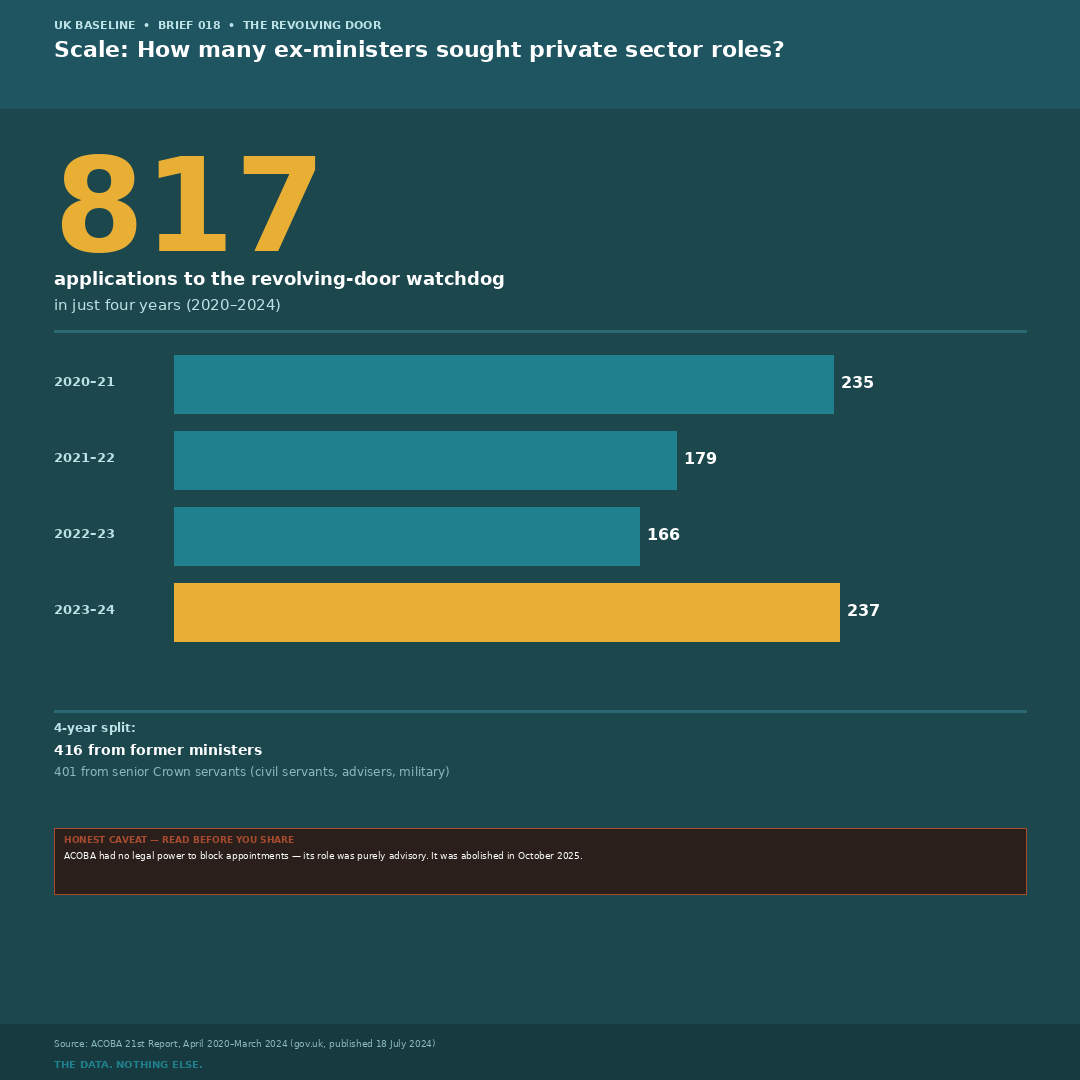
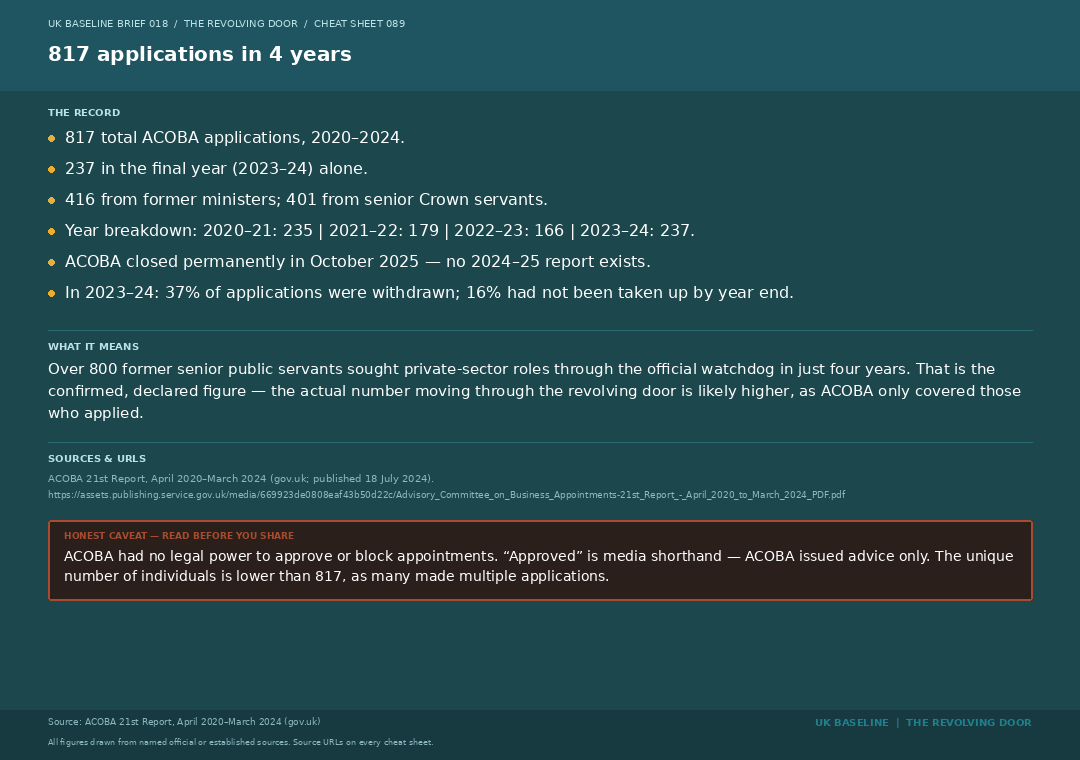
Between 2020 and 2024, 817 applications were made to the Advisory Committee on Business Appointments (ACOBA) — the UK government's official revolving door watchdog — by former ministers and senior Crown servants seeking to move into private sector roles. In the final full year before ACOBA's abolition (2023–24), 237 applications were received. Of the four-year total, 416 came from former ministers and 401 from senior Crown servants including civil servants, special advisers, and military personnel.
- 817 applications across the four reporting years, covering 328 individuals
- 416 applications were from former ministers; 401 were from senior Crown servants
- 237 applications were received in 2023–24, the final full reporting year
- ACOBA ceased operating in October 2025; functions moved to the Independent Adviser on Ministerial Standards and Civil Service Commission
- Source: ACOBA 21st Report, April 2020 to March 2024; The Constitution Society
Did ACOBA ever sanction a minister for breaching the rules?
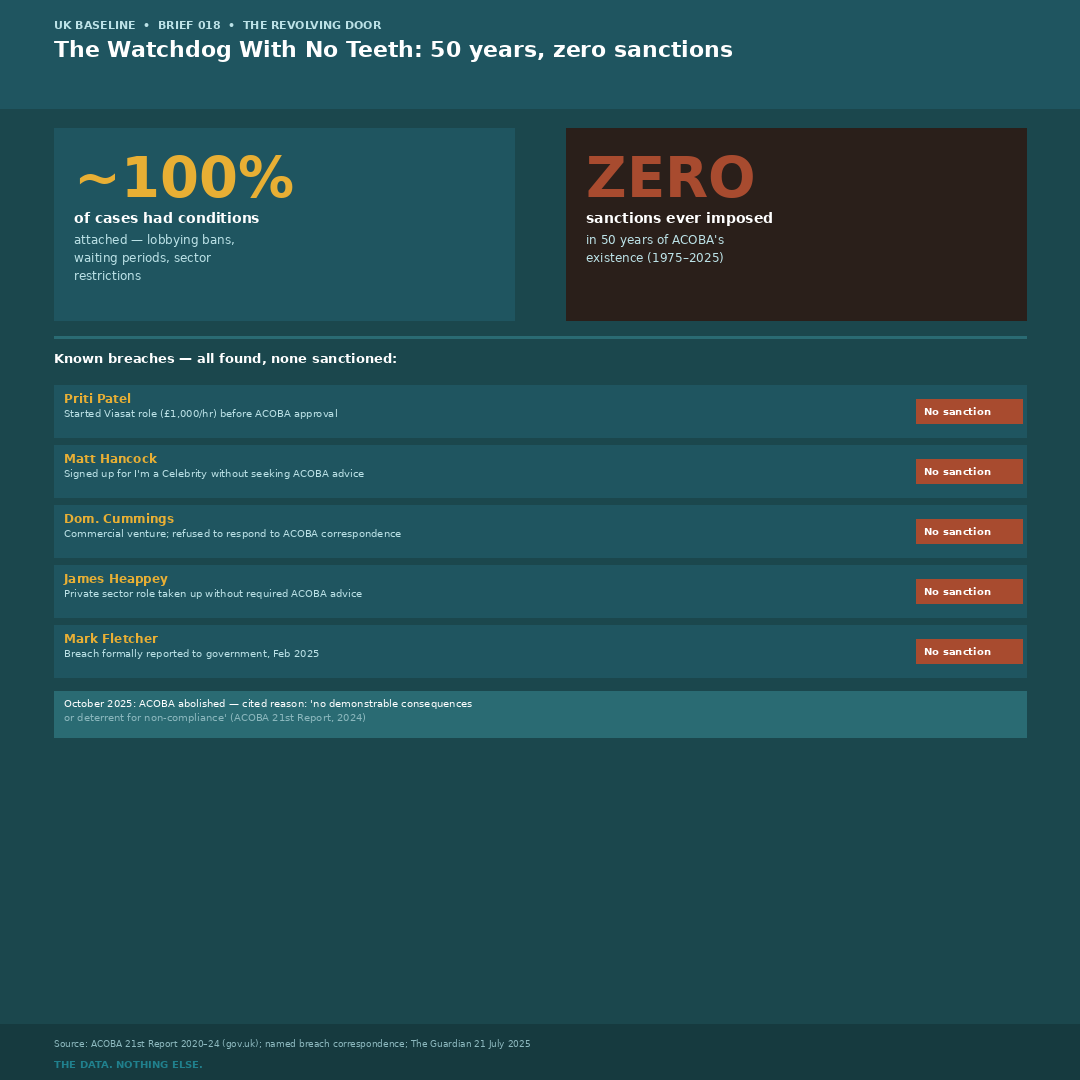
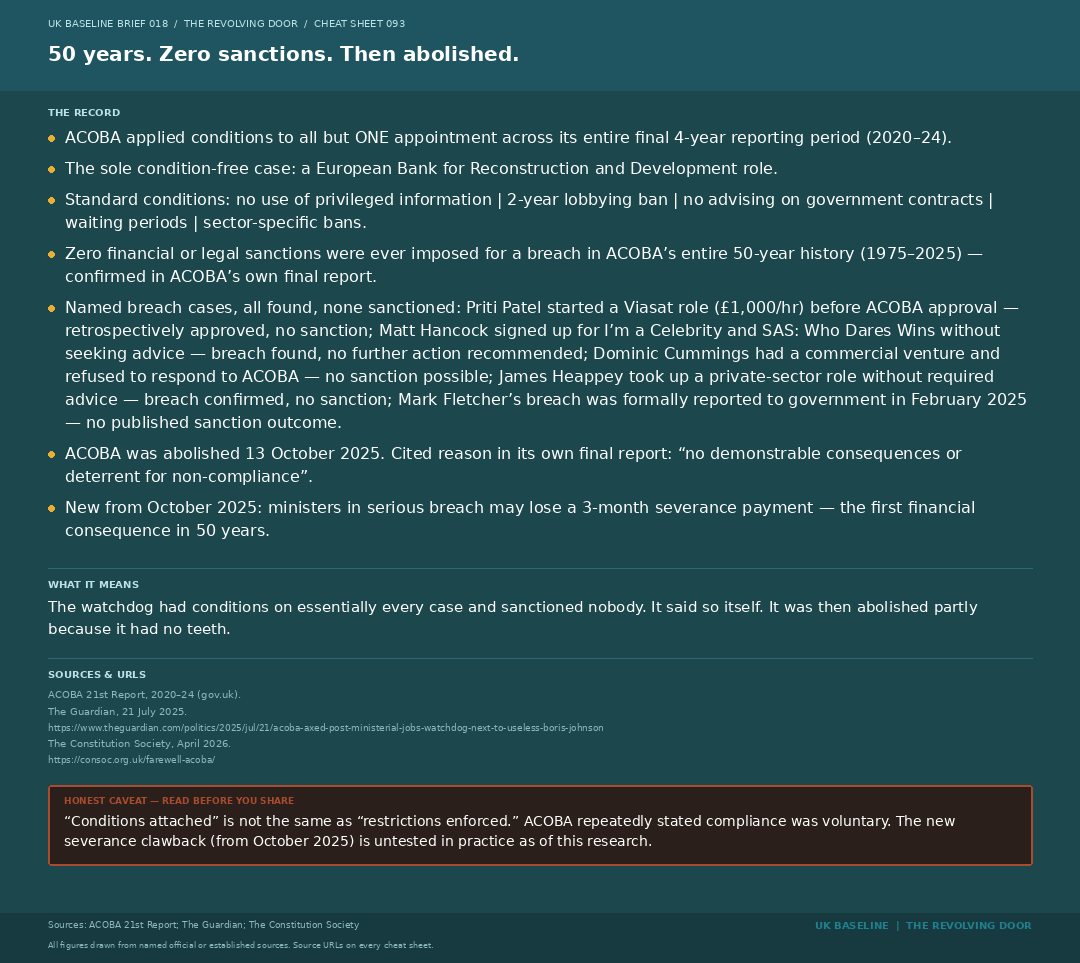
No. In its entire 50-year history from 1975 to 2025, ACOBA imposed zero financial or legal sanctions for a breach of the Business Appointment Rules. ACOBA attached conditions to all but one of the appointments it advised on across its final four-year reporting period — standard conditions included a two-year lobbying ban, restrictions on use of privileged information, and sector-specific limitations. Yet when ministers breached these conditions or failed to seek ACOBA's advice altogether, the committee had no legal power to act. It could only report the breach and hope for voluntary compliance.
- All but one of the appointments advised on in 2020–24 had restrictions attached
- Standard conditions included a two-year lobbying ban and restrictions on privileged information
- ACOBA reported that there were “no demonstrable consequences or deterrent for non-compliance”
- Publicly reported breaches included Boris Johnson's Daily Mail appointment, Dominic Cummings' paid Substack work and Philip Hammond's Treasury contact on behalf of OakNorth
- Source: ACOBA 21st Report; ACOBA correspondence; The Guardian
Which government departments produced the most revolving door cases?
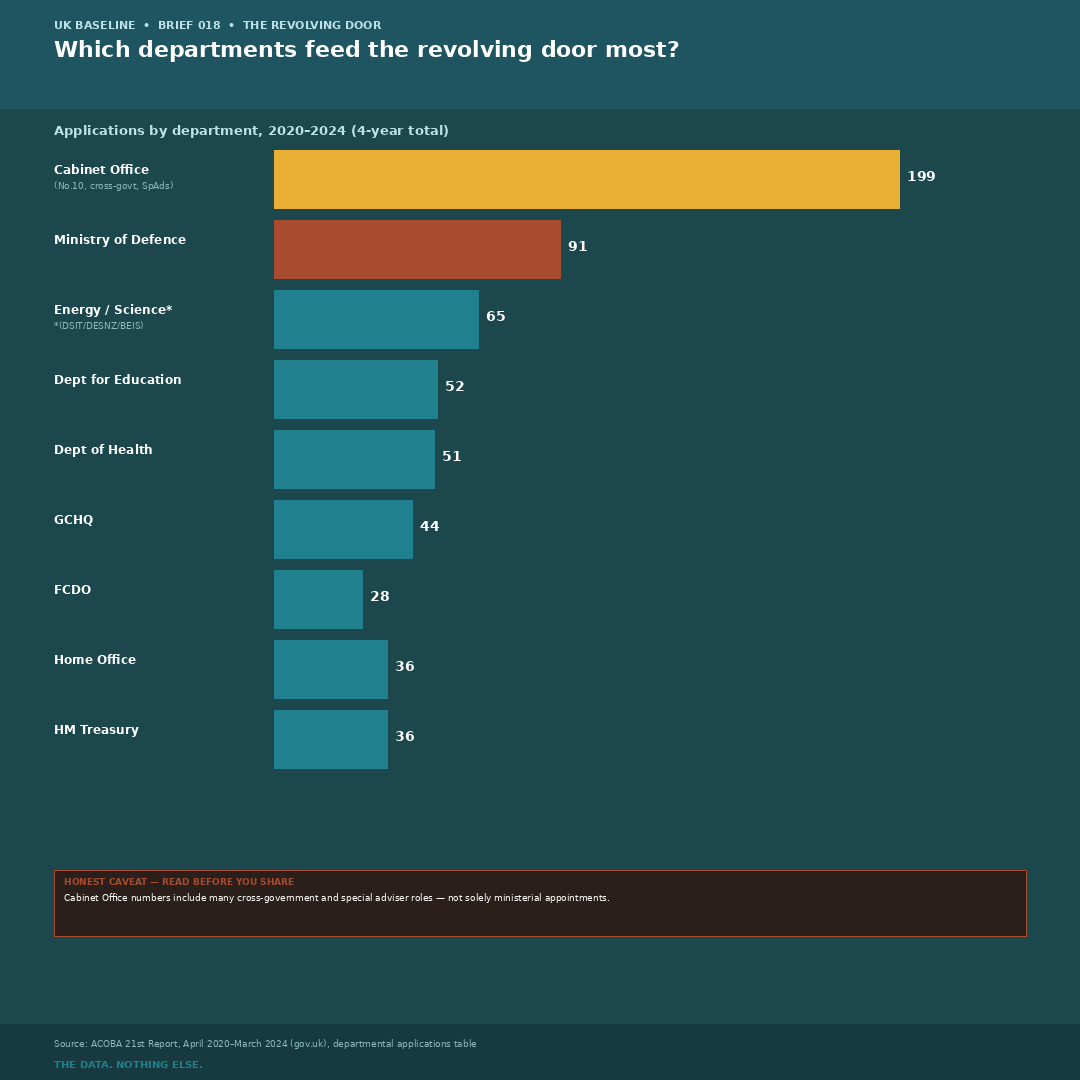
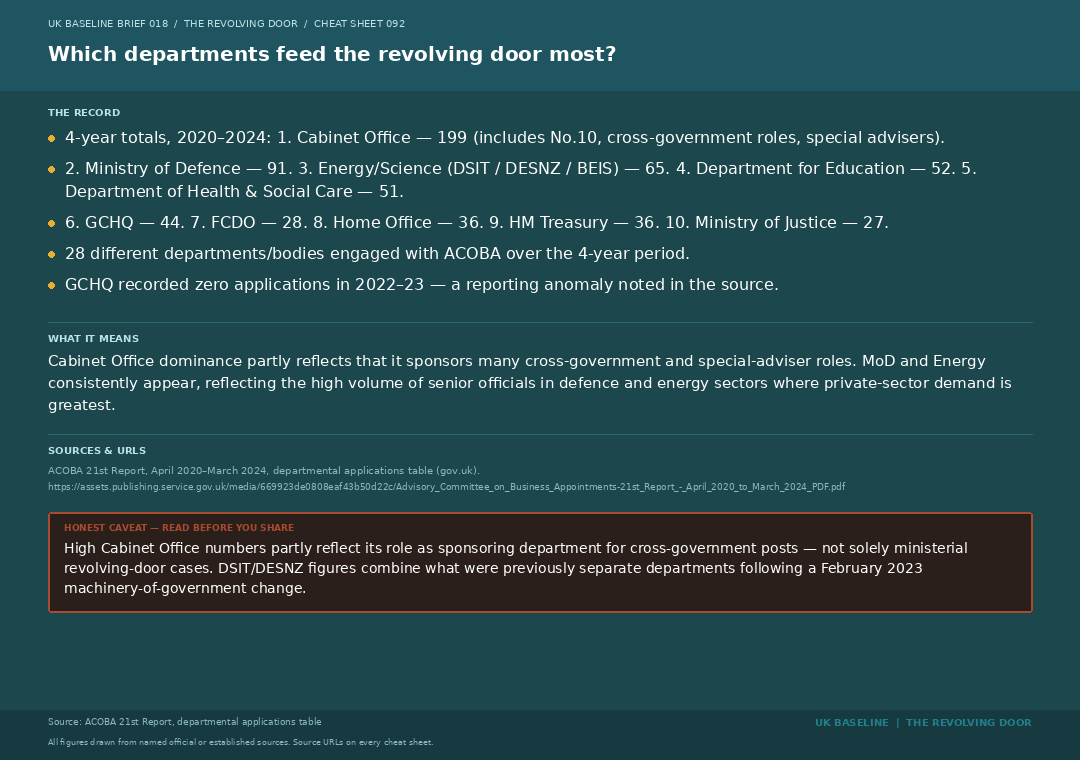
The Cabinet Office generated the most ACOBA applications across 2020–2024, with 199 over the four-year period — reflecting its role as the sponsoring department for many cross-government and special adviser positions. The Ministry of Defence was second with 91, followed by the combined Energy and Science departments (DSIT/DESNZ/BEIS) with 65, the Department for Education with 52, and the Department of Health and Social Care with 51. A total of 28 different departments and bodies engaged with ACOBA during the reporting period.
- Cabinet Office: 199 applications, including cross-government and special adviser roles
- Ministry of Defence: 91 applications
- Combined DSIT, DESNZ and BEIS: 65 applications
- Department for Education: 52; Department of Health and Social Care: 51
- 28 departments and bodies engaged with ACOBA in the reporting period
- Source: ACOBA 21st Report
Which private sector industries recruited the most former ministers?
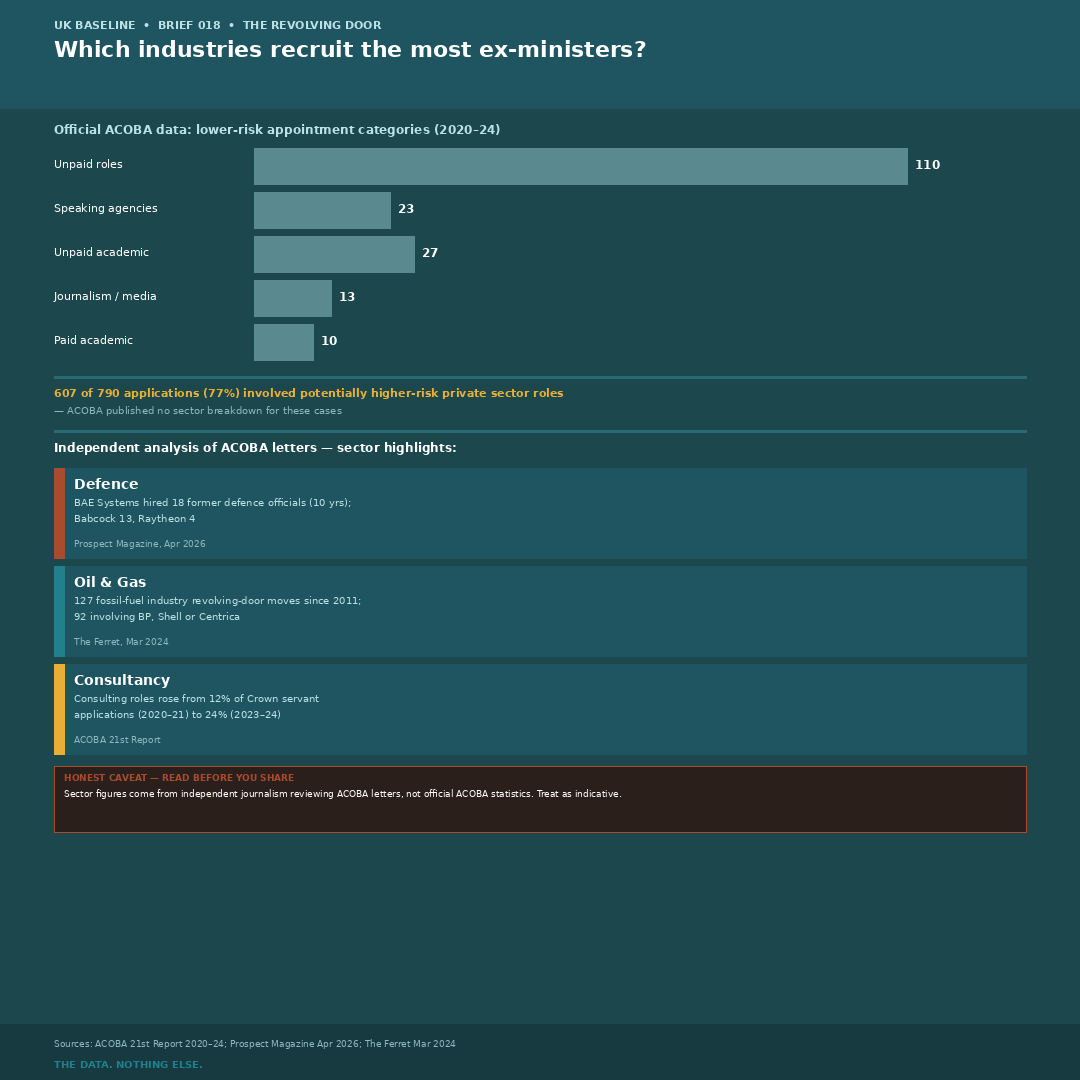
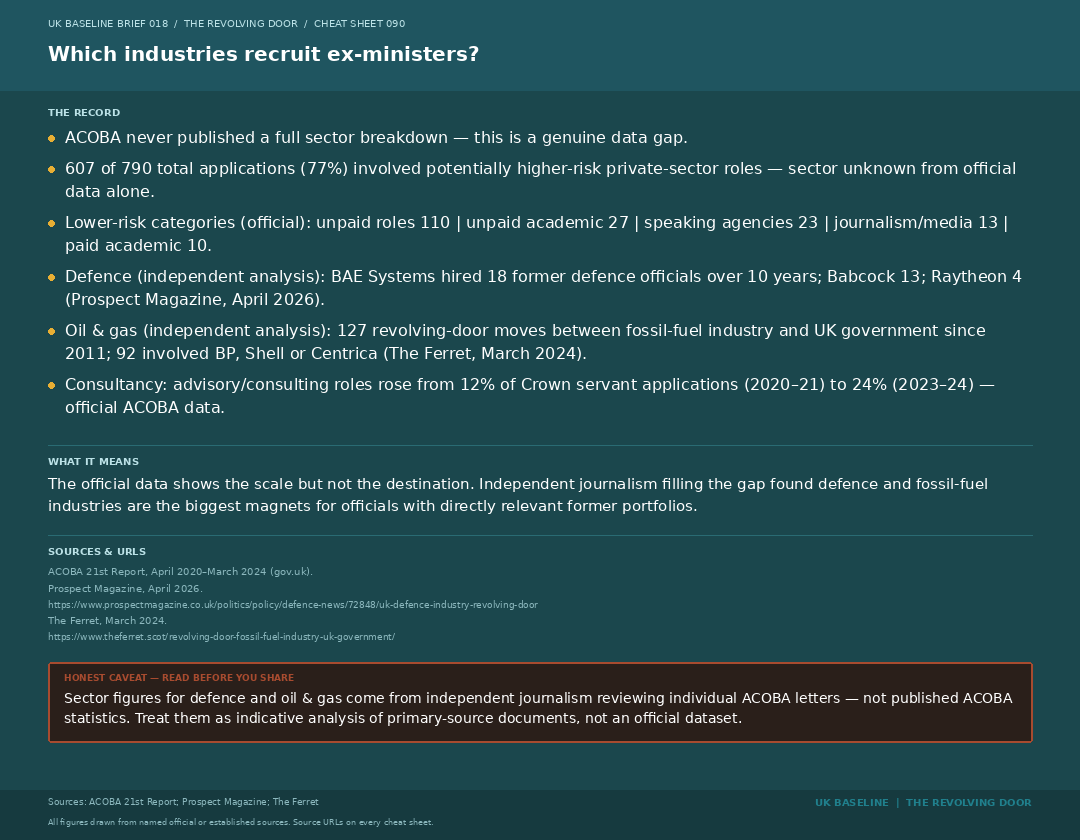
ACOBA never published a full sector breakdown — this is a genuine gap in the official data. Of the 790 applications it processed, 607 (77%) fell outside its "lower-risk" categories, meaning they involved potentially higher-risk private sector roles, but the sectors were not publicly recorded. Independent analysis of individual ACOBA letters by Prospect Magazine found that BAE Systems recruited 18 former defence officials over a decade, with Babcock taking 13. The Ferret's review of 1,800 ACOBA letters found 127 revolving-door moves between fossil fuel companies and UK government since 2011, 92 of which involved BP, Shell, or Centrica. Within ACOBA's own published data, consulting and advisory roles rose from 12% of Crown servant applications in 2020–21 to 24% in 2023–24.
- ACOBA did not publish a complete sector-by-sector dataset
- 607 of 790 processed applications (77%) were outside the committee's lower-risk categories
- Prospect identified 18 former defence specialists recruited by BAE Systems and 13 by Babcock over a decade
- The Ferret identified 127 fossil-fuel revolving-door moves since 2011, including 92 involving BP, Shell or Centrica
- Consulting and advisory roles rose from 12% to 24% of Crown servant applications across the period
- Source: ACOBA 21st Report; Prospect Magazine; The Ferret
How quickly could former ministers start private sector roles?
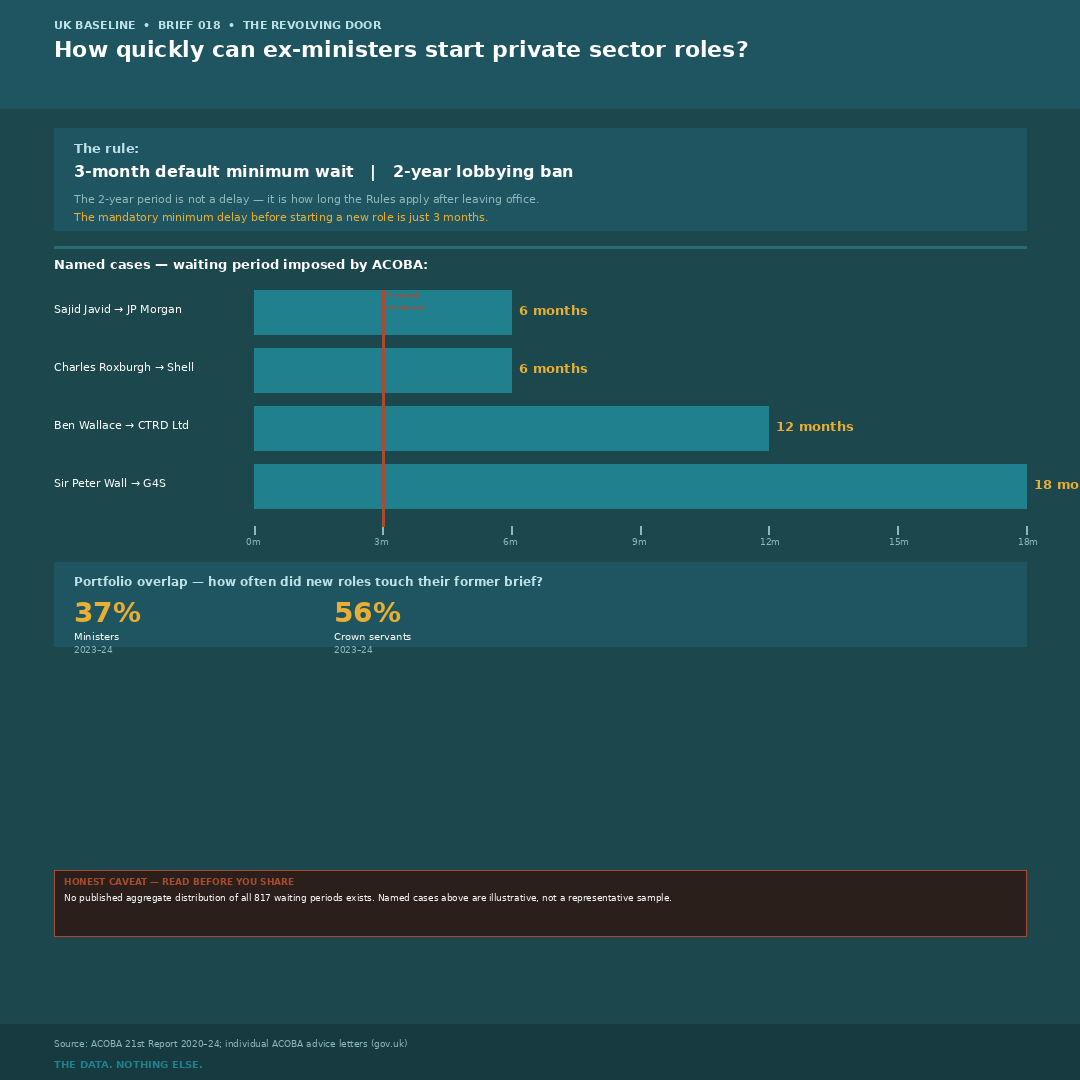
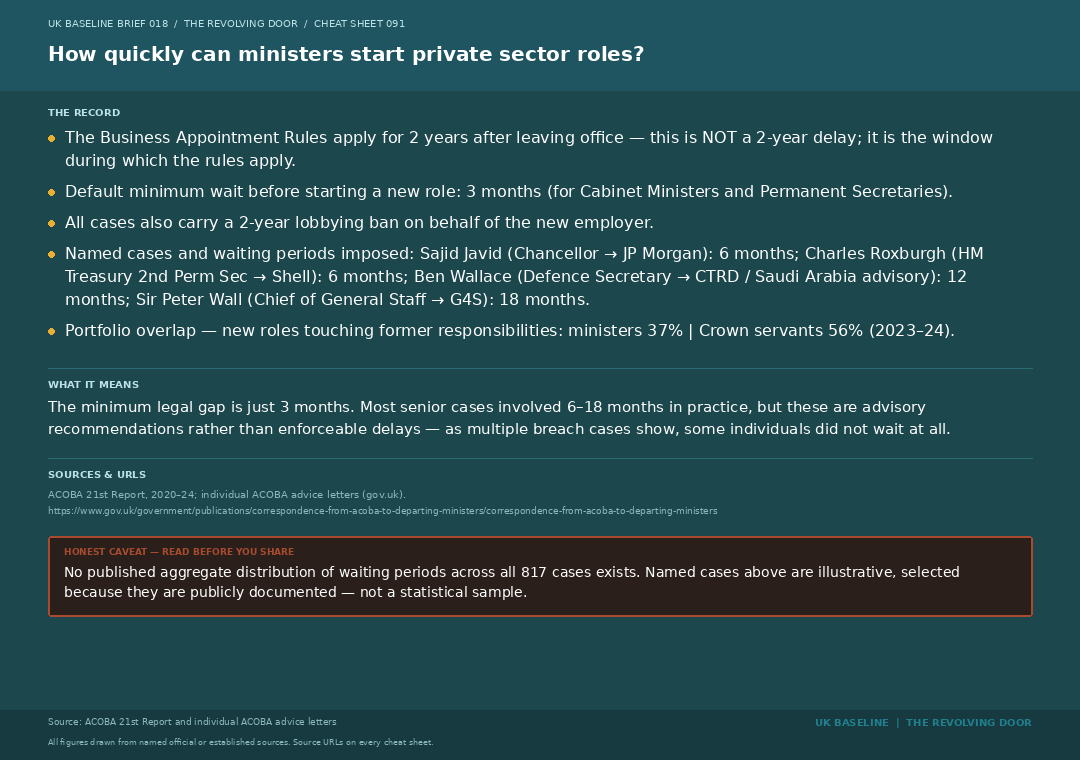
The Business Appointment Rules applied for two years after a minister left office — but this was not a two-year delay. The default minimum waiting period before starting a new role was just three months for Cabinet Ministers and Permanent Secretaries, with a two-year lobbying ban running in parallel. In practice, documented cases show waiting periods ranging from six months (Sajid Javid to JP Morgan; Charles Roxburgh to Shell) to twelve months (Ben Wallace to CTRD) to eighteen months (Sir Peter Wall to G4S). In 2023–24, 37% of new ministerial roles overlapped with the applicant's former portfolio.
- The rules covered two years after departure, but the default minimum wait was three months for Cabinet Ministers and Permanent Secretaries
- Documented waits: Sajid Javid to JP Morgan, six months; Charles Roxburgh to Shell, six months
- Ben Wallace to CTRD, twelve months; Sir Peter Wall to G4S, eighteen months
- 37% of new ministerial roles in 2023–24 overlapped with the applicant's former portfolio
- Source: ACOBA 21st Report; published ACOBA appointment letters
Which former ministers moved into roles linked to their old portfolios?
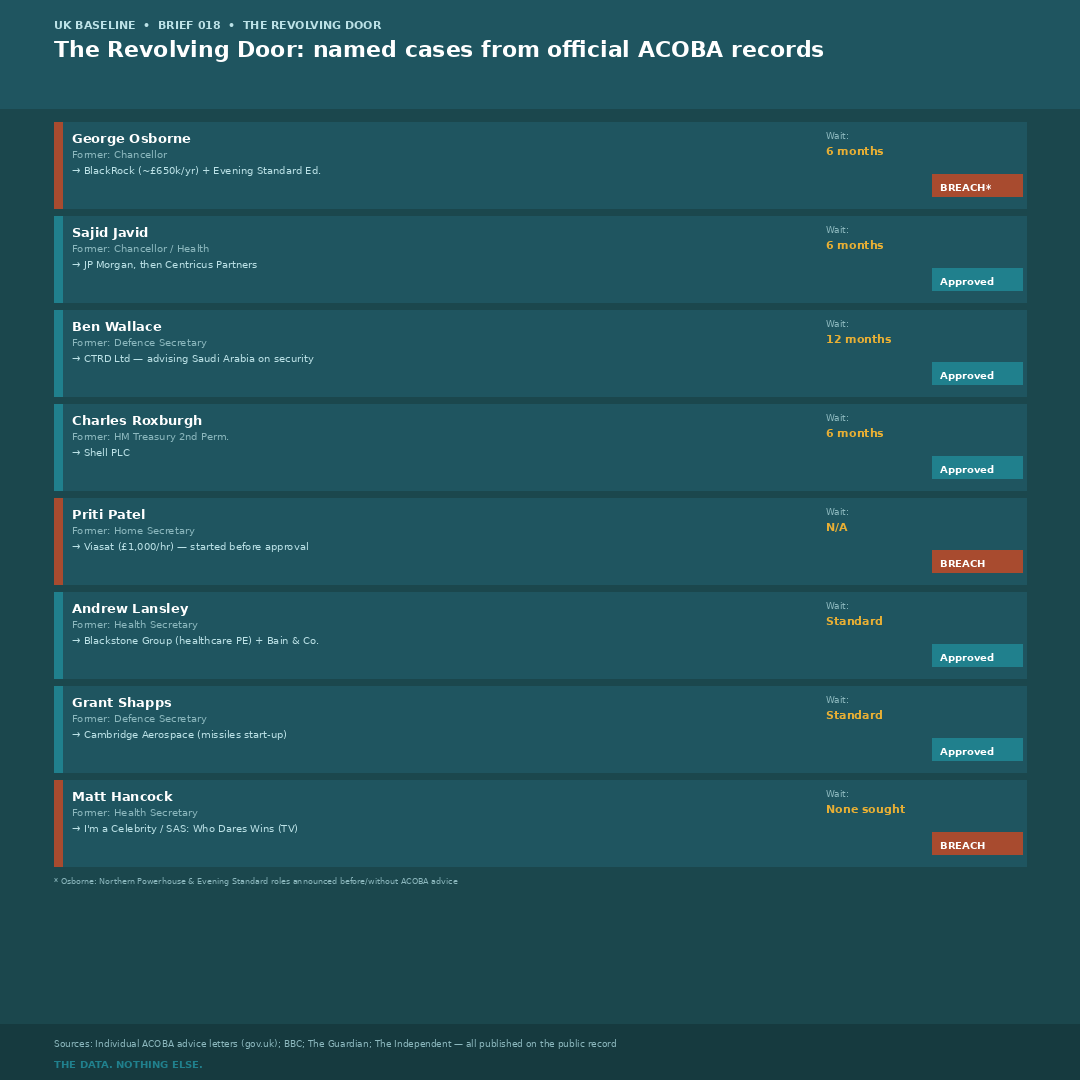
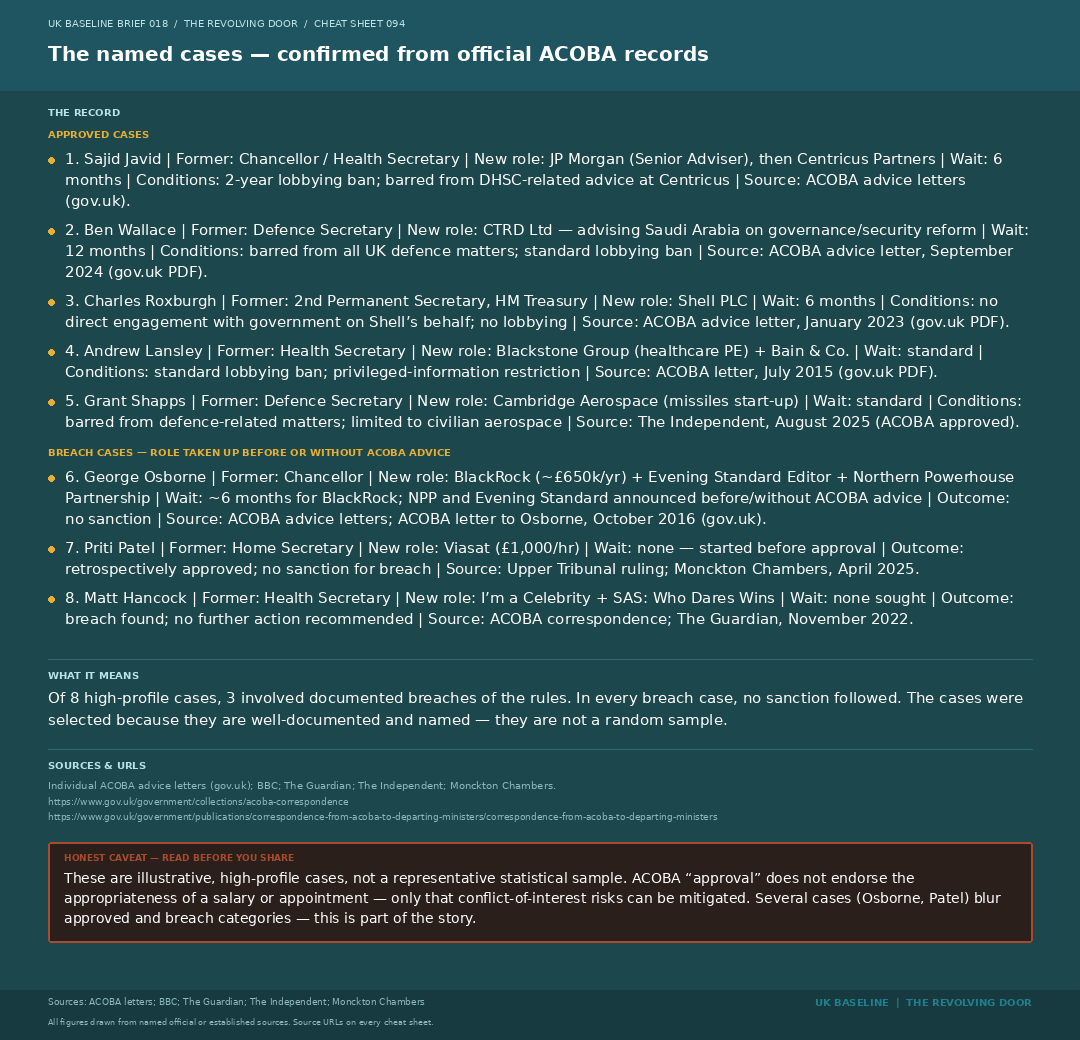
Eight high-profile cases are documented from publicly available ACOBA letters and published correspondence. They span former Chancellors moving into banking (George Osborne to BlackRock, Sajid Javid to JP Morgan), a former Defence Secretary advising on Saudi security reform (Ben Wallace, CTRD Ltd), a senior Treasury official joining Shell (Charles Roxburgh), and a former Health Secretary advising healthcare private equity (Andrew Lansley, Blackstone Group). Three of the eight cases involved documented breaches of the rules — appointments taken up before or without ACOBA's advice — in every case without sanction.
- George Osborne: former Chancellor to BlackRock; Sajid Javid: former Chancellor to JP Morgan
- Ben Wallace: former Defence Secretary to CTRD Ltd, advising on Saudi security reform
- Charles Roxburgh: former senior Treasury official to Shell
- Andrew Lansley: former Health Secretary to Blackstone Group
- Three of the eight documented cases involved a recorded breach; no financial or legal sanction followed
- Source: published ACOBA letters and correspondence; The Guardian
Read Before You Record
The underlying application data is official, but it is not a complete register of all movements between government and industry. Keep these qualifications with any retelling of the brief.
- ACOBA covered former ministers and the most senior Crown servants, not every public official or all forms of post-public-service employment. The 817 figure counts applications rather than unique individuals.
- ACOBA did not publish a complete sector classification. The industry figures in this brief come from transparent independent analysis of published letters and should not be treated as a full census of private-sector recruitment.
- A condition or waiting period is not evidence of wrongdoing. The figures describe applications and the risk-management framework; documented breaches are separately identified through published correspondence.
Sources
The full source list below links to the underlying official data and supporting reporting used in this brief.
- ACOBA 21st Report, April 2020 to March 2024 (gov.uk)
- Prospect Magazine, “The defence industry's revolving door”
- The Ferret, “Revealed: the revolving door between fossil fuel industry and the UK government”
- The Guardian, “Acoba axed: how the post-ministerial jobs watchdog proved ‘next to useless’”
- The Constitution Society, “Farewell to the Advisory Committee on Business Appointments”